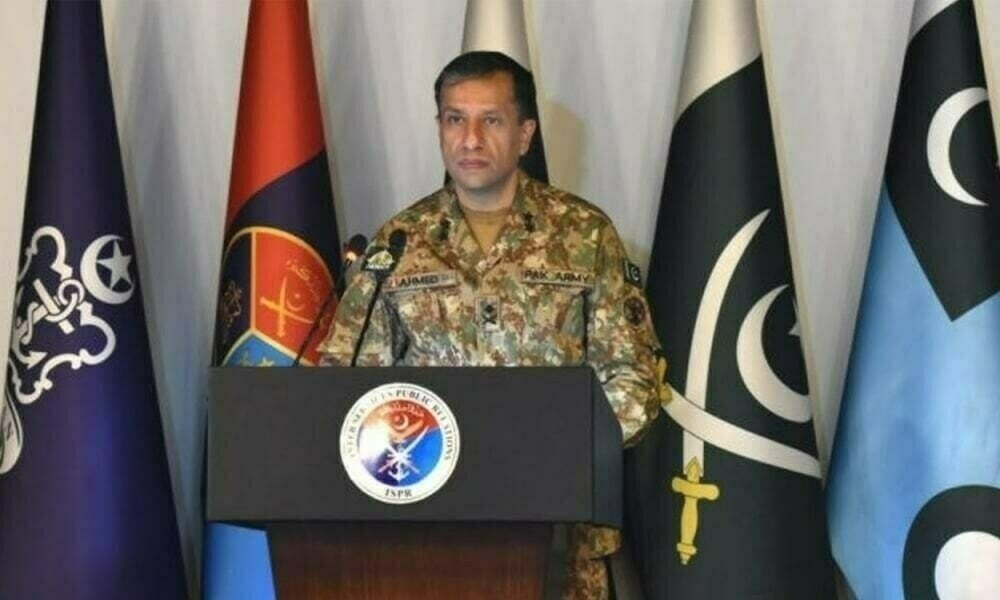
Director General of Inter-Services Public Relations (ISPR), Lieutenant General Ahmed Sharif Chaudhry, declared on Friday that the state is exercising maximum wisdom and operational restraint regarding recent political unrest in Azad Jammu and Kashmir (AJK).
Addressing a comprehensive live press conference at General Headquarters (GHQ), the military spokesperson emphasized that public will must be channeled exclusively through constitutional and electoral processes, adding that anyone resorting to violence or mob rule will be held strictly accountable under the law.
Political Rights, Constitutional Obligations, and AJK Restraints
Lieutenant General Ahmed Sharif Chaudhry addressed the ongoing political friction surrounding the 12 general seats in AJK, framing the situation through the lens of constitutional compliance and public representation:
-
Political Supremacy & Electoral Integrity: The DG ISPR reiterated that political leaders and democratic processes must dictate the path forward. “The will of the people will be decided by the politicians… Stagnation is not the solution to anything. Even still water begins to stink after a while,” he remarked, emphasizing that the electoral process will proceed uninterrupted to form legitimate assemblies.
-
State Monopoly on Legitimate Violence: Responding to violent protests, the spokesperson asserted that while the state has demonstrated generosity by facilitating political participation, it will not yield to mob coercion. “Do remember that only the state has the monopoly on violence and we cannot allow a mob to have its way,” he warned.
-
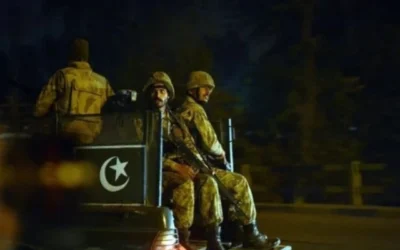
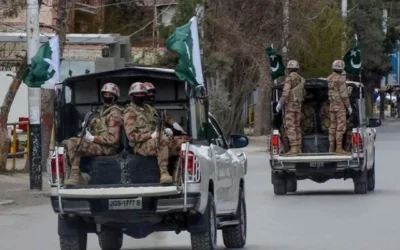
Role of Civil Administration: Clarifying the military’s operational boundary, Lt Gen Chaudhry confirmed that the Pakistan Army is not involved in handling the local situation in AJK, noting that administrative and security matters rest entirely with the AJK government, the civilian police, and civil armed forces.
-
Rebuffing Historical Misinformation: The spokesperson strongly rejected recent digital campaigns attempting to vilify Kashmir’s founding leaders, Sardar Ibrahim Khan and Sardar Abdul Qayyum Khan, or labeling the Pakistan Army as an “occupying force.” He highlighted that over 100,000 Kashmiris serve within the Pakistan Army—including two former Corps Commanders—and recalled that the nation’s first Nishan-e-Haider recipient, Captain Sarwar Shaheed, sacrificed his life for Kashmir’s liberation.
Key Policy Takeaways — DG ISPR Press Briefing:
- AJK Situation: Electoral process to continue; local law enforcement managing civil order.
- Counter-Terrorism Momentum: 40,348 IBOs conducted in 2026; 2,084 terrorists eliminated (~10 per day).
- Strategic Stance on Kashmir: Reaffirmed as “jugular vein”; solution anchored in UNSC resolutions.
- Administrative Reset: Governance reforms supported if executed through legal, constitutional channels.
National Security Baseline: 40,000+ Operations and Counter-Terror Metrics
Outlining the broader security spectrum, the DG ISPR revealed that Pakistan’s armed forces and law enforcement agencies have conducted 40,348 intelligence-based operations (IBOs) across the country in 2026—averaging nearly 194 operations daily, with the heaviest concentration in Balochistan.
- Total IBOs Executed: 40,348 nationwide (avg. 194 per day)
- Terrorist Casualties: 2,084 eliminated (avg. 10 per day)
- Total Martyrdoms: 819 (303 Pak Army, 194 LEAs, 322 Civilians)
- Foreign Footprint: Majority of 28 suicide bombings executed by Afghan nationals
- Contraband Interdictions: 4bn in illegal trade seized; Rs18bn in narcotics recovered
The military spokesperson highlighted a decisive structural shift in kinetic engagements: while martyr-to-terrorist casualty ratios favored insurgent networks in 2023, continuous operational refinement under Operation Shaban and Operation Ghazab Lil Haq resulted in security forces taking out more than two combatants for every fell soldier by 2025 and 2026.
Director General ISPR sheds light on counterterrorism statistics in Pakistan so far this year, in 2026: pic.twitter.com/MLuS9Qxit8
— The STRATCOM Bureau (@OSPSF) July 31, 2026
The Balochistan Landscape: Governance, Border Hardening, and Disinformation Networks
Devoting a major portion of the briefing to Balochistan, Lt Gen Chaudhry dissected the structural, external, and administrative dynamics shaping the province’s security environment:
Dismantling the Feudal-Militant Nexus
The DG ISPR identified entrenched “sardarism” and elite status-quo preservation as prime movers of regional instability. He argued that certain legacy elites resist educational and infrastructure development to retain feudal dominance, leveraging militant proxies to pressure the state when their illegal revenue streams—such as fuel and narcotics smuggling—are targeted.
Hardening the Western Border & Anti-Smuggling Operations
To break the terror-crime matrix, the state has instituted strict border protocols along the Durand Line, repatriating roughly 2.6 million undocumented foreign nationals (including 600,000 in 2026 alone). Furthermore, authorities successfully disrupted a nationwide fuel-smuggling enterprise that previously siphoned up to 20.5 million liters per day, redirecting resources toward public sector development.
Balochistan Socio-Economic & Connectivity Matrix:
- Infrastructure: 12 major road highways; N-25 expansion; 52 of 100 planned dams completed
- Public Engagement: 703 open civic forums conducted; 51% of local grievances resolved on-site
- Education & Health: 10,800 youth receiving IT training annually; 60 new educational facilities monthly
Countering Digital Hybrid Warfare
Exposing hostile propaganda structures, the spokesperson detailed how over 300 Indian-run websites and 1,000 social media accounts coordinate with regional insurgent elements—such as “Fitna al-Hindustan” and Afghan Taliban-linked Khawarij—to amplify disinformation. He demonstrated how localized incidents are systematically “seeded” on Telegram, framed by digital initiators, and scaled up through foreign media outlets to manufacture false narratives of state repression.
Strategic Analysis: Governance Imperatives and Constitutional Sovereignty
The DG ISPR’s address articulates a clear doctrine balancing kinetic military action with structural civilian governance:
Governance as the Ultimate Security Anchor
By explicitly endorsing an “administrative reset” and acknowledging that population growth (expanding from 65 million in 1972 to 250 million today) requires evolving administrative structures, the military leadership is placing the burden of long-term stability back onto political institutions. The military’s position is clear: kinetic operations under the National Action Plan (NAP) can clear operational space, but durable security remains unattainable without effective public service delivery, anti-corruption measures, and local empowerment.
Rejection of Hard-State Elitism in Favor of Rule of Law
The spokesperson’s assertion that Pakistan is “not a hard state” serves as a direct critique of systemic elitism. Defining a true “hard state” as one where the law applies equally to all citizens regardless of status, the military leadership signaled an end to legacy policy approaches that sought to appease feudal intermediaries or non-state actors. Moving forward, citizen engagement will occur directly through constitutional mechanisms rather than informal bargains with political elites.
Immutable Posture on Kashmir Deterrence
By linking historical conflicts (18-day military engagements in 2019 and May 2025) to current hybrid threats, the military spokesperson underscored that external attempts to destabilize Pakistan from within stem directly from India’s inability to alter conventional military outcomes. Reaffirming Kashmir as Pakistan’s “jugular vein” grounded in binding UN Security Council resolutions, Islamabad signals that internal political challenges will not compromise its strategic posture or legal stance on the Kashmir dispute.