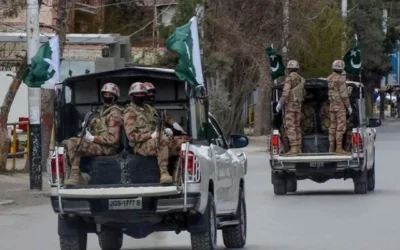

In an intelligence-driven operation, Pakistan’s security forces killed ten militants and apprehended two female suicide bombers alongside their direct facilitator during targeted sweeps across Balochistan’s Surab and Mastung districts over the past 48 hours.
According to an official statement released by the Inter-Services Public Relations (ISPR) on Wednesday afternoon, seven militants were eliminated in Surab, while three were neutralized in Mastung. The state media wing confirmed that the operations form part of an ongoing, continuous campaign targeting the network of state-designated hostile groups “Fitna-al-Hindustan” and “Fitna-al-Khawarij”.
In continuation of security forces operations against the terrorists nexus of Indian sponsored Fitna al Hindustan and Fitna al Khwarij, comprehensive joint operations are being carried in different parts of Balochistan to weed out remnants of terrorists and their facilitators.… pic.twitter.com/TfCyiA0k2M
— DG ISPR (@OfficialDGISPR) July 22, 2026
Tactical Successes and Recoveries
The dual-district security operation targeted active cells operating along strategic transit routes in central Balochistan:
-
Surab Engagement: Forces conducted high-intensity sanitization sweeps in Surab, eliminating seven armed operatives following prolonged exchanges of fire.
-
Mastung Interceptions: Operational units in Mastung neutralized three militants and successfully disrupted a high-value suicide cell, capturing two female suicide bombers and their primary logistical handler.
-
Affiliation and Materiel: ISPR confirmed that the apprehended suicide bombers and their facilitator were affiliated with Fitna-al-Hindustan. Large caches of military-grade weapons, tactical ammunition, and improvised explosive devices (IEDs) were recovered during the raids.
-
Sustained Sanitization: Active clearance operations remain underway across the surrounding terrain to track down secondary logistical links and ensure no remaining hostile elements persist in the sector.
The Broader Landscape: Operation Shaban and Azm-i-Istehkam
The recent sweeps in Surab and Mastung reflect a broader military intensification across Balochistan following sharp security escalations earlier in the month:
-
Operation Shaban Escalation: Security forces launched Operation Shaban in early July in response to the Mangi Dam checkpoint assault in Ziarat, where militants executed 27 police officers. The ongoing military response has accounted for the deaths of over 120 insurgents across multiple districts.
-
Azm-i-Istehkam Framework: The military reiterated that all ongoing counter-terrorism operations are being executed under the strategic “Azm-i-Istehkam” vision approved by the Federal Apex Committee on the National Action Plan, aimed at systematically dismantling foreign-backed proxy infrastructure.
-
Rising Regional Volatility: Monthly security data from the Pakistan Institute for Conflict and Security Studies (PICSS) recorded a 109 percent surge in terrorist incidents in Balochistan during May, alongside a dramatic spike in cross-district kidnappings that prompted top-level civil-military strategy reviews in Quetta.
Strategic Analysis: Shifting Tactics, External Proxies, and Dual-Track Security
The interception of female suicide bombers in Mastung underscores an evolving, highly complex counter-terrorism paradigm in Balochistan:
The Operational Shift to Asymmetric Human Targets
The capture of female suicide operatives highlights a tactical evolution by insurgent networks aiming to bypass traditional military checkpoints and exploit societal norms surrounding gender security checks. By deploying female operatives, militant leadership seeks to increase the surprise factor and lethality of attacks against high-value state infrastructure and military convoys. The successful intelligence-led apprehension of these operatives before deployment indicates a significant operational victory for domestic signal and human intelligence networks.
Formalization of the “Fitna-al-Hindustan” Narrative
The explicit attribution of these cells to “Fitna-al-Hindustan” signals a formalized strategic effort by Islamabad to reframe the Balochistan insurgency from an internal socio-political friction to an externally managed, state-sponsored proxy war. Following public statements by the military leadership pointing to external sanctuary hubs in Afghanistan and financial support from Indian intelligence apparatuses, the state is signaling that its counter-insurgency framework will treat local insurgent remnants strictly as external combatants, shutting the door on non-conditional negotiations.
Institutional Mobilization Under Unified Command
With Chief of Defence Forces (CDF) Field Marshal Asim Munir and Prime Minister Shehbaz Sharif establishing a unified civil-military posture at the Apex Committee level, the state is deploying full operational weight behind Operation Shaban. By combining targeted intelligence-based strikes with broader regional sanitization, the military is seeking to re-establish control over crucial trade and energy transport corridors connecting northern Balochistan to Gwadar and the broader provincial hinterlands.