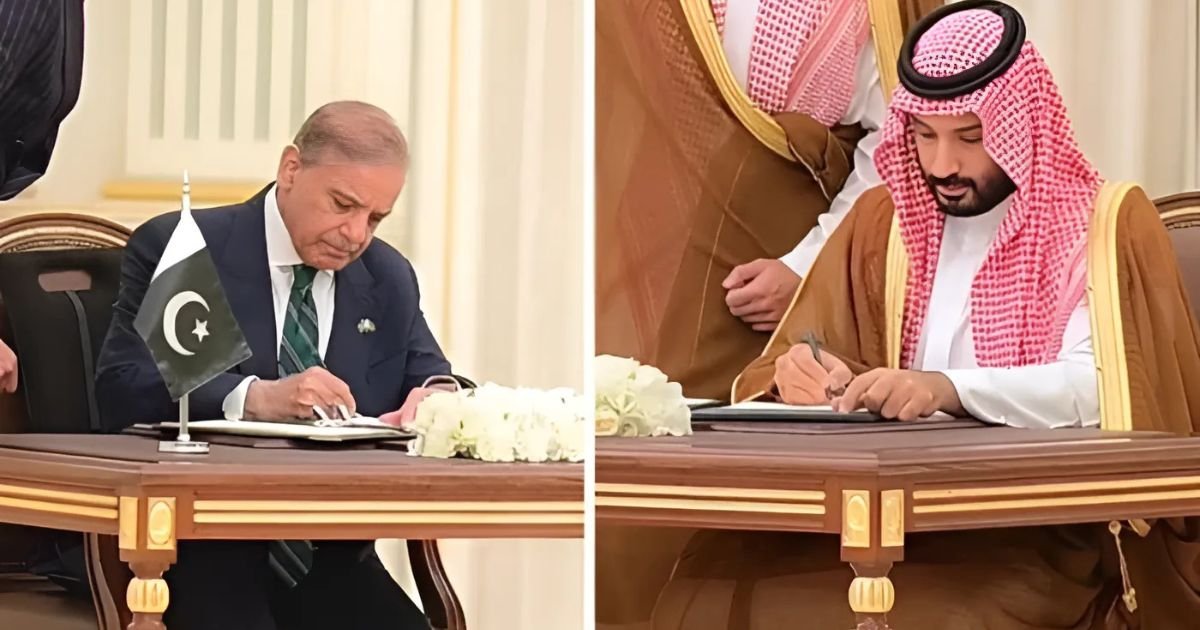
On 17 September 2025, Prime Minister Muhammad Shehbaz Sharif and the Saudi Crown Prince Mohammed bin Salman signed a Strategic Mutual Defense Agreement at Riyadh. The ceremony took place at Al-Yamamah Palace. Field Marshal Asim Munir, the Army Chief of Pakistan, also attended the ceremony. The agreement stated that attacking one nation would be considered an attack on both, reinforcing mutual deterrence. It was a historic accord. The agreement solidified a several-decade-old relationship. It was termed a watershed moment by media houses.
The Agreement was signed right after the deadly attack on Hamas Leaders by Israel in Qatar, which caused a wave of condemnation throughout the Muslim world. This timing indicates that there is a collective action by Muslim states to address the tension in the region. This pact represents a major boost in the Pakistani-Saudi relations, a combination of military strength and diplomatic symbolism.
To Pakistan, the agreement serves as a deterrent to regional aggression and a diplomatic victory in the Gulf. Security relations that Islamic Pakistan has maintained with the Gulf have progressed from informal guarantees to a formal defense partnership, making Pakistan a more strategic player in the Muslim world.
The Crown Prince and Prime Minister of the Kingdom of Saudi Arabia H.R.H. Muhammad bin Salman bin Abdulaziz Al Saud and Prime Minister Muhammad Shehbaz Sharif exchange the documents of the Strategic Mutual Defense Agreement (SMDA) in Riyadh.#PMShehbazInKSA… pic.twitter.com/hJSft3GnyG
— Government of Pakistan (@GovtofPakistan) September 17, 2025
Context and Background
Over the decades, there has been a close security relationship between Pakistan and Saudi Arabia. In 1947, Saudi Arabia was one of the earliest countries to accept Pakistan, and in 1951, both countries signed a Treaty of Friendship. Pakistan trained thousands of Saudi military personnel over the years and even deployed battalions to protect the sacred places of Makkah and Medina. Riyadh also emerged as a consistent financial and energy supporter. Pakistan was frequently supported by Saudi loans and aid to stabilize its shaky economy.
Islamabad, in turn, indicated it would protect the kingdom in case of need. Even analysts observe that Saudi Arabia had even backed the nuclear program of Pakistan, which they considered a Pakistani protection as critical against Iran. Up until now, this alliance was a practice rather than a treaty.
The new agreement alters that fact. It is the first formal mutual defense agreement of Pakistan after its independence. The pact formalizes almost 8 decades of collaboration. It also demonstrates that the two states are united not only through religion and history but also through common strategic interests and military relations.
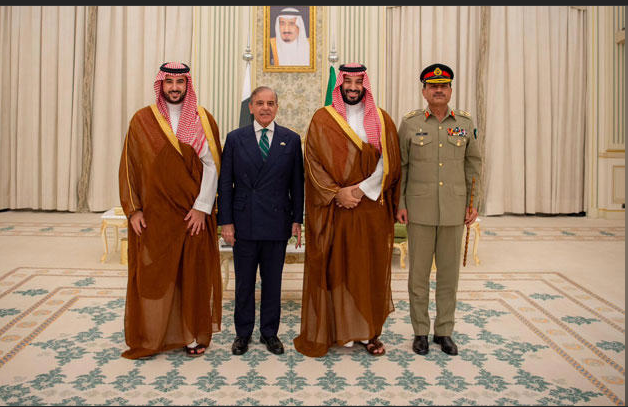
Source: Daily Times (Pk)
September 2025: Visits and Meetings
This defense agreement was signed when Prime Minister Sharif made a state visit to Saudi Arabia. His trip came after a regional crisis. Israel carried out an airstrike on September 9 in Doha that killed Hamas leaders. Shaking Gulf capitals, the attack provoked an emergency summit in Doha on September 15. The meeting was hosted by Riyadh along with Pakistan. OIC and the Arab League joined and agreed on a joint defense mechanism. On September 17, two days later, Sharif flew to Saudi Arabia on the invitation of Crown Prince Mohammed bin Salman. His plane was escorted by Saudi Air Force jets as it flew over Saudi airspace. It is a rare honor. The Crown Prince welcomed him at Al-Yamamah Palace, with all the ceremonials and a guard of honor.
وزیرِ اعظم محمد شہباز شریف سعودی ولی عہد و وزیرِ اعظم شہزادہ محمد بن سلمان سے ملاقات کیلئے سعودی شاہی دیوان، قصر یمامہ پہنچے. شاہی دیوان پہنچنے پر وزیرِ اعظم کا سعودی شاہی پروٹوکول کے ساتھ گھڑ سواروں نے استقبال کیا.
شاہی دیوان پہنچنے پر سعودی ولی عہد و وزیرِ اعظم شہزادہ محمد بن… pic.twitter.com/wlx40wV0lm
— PTV News (@PTVNewsOfficial) September 17, 2025
Both parties presented the best delegations. Crown Prince Mohammed bin Salman was accompanied by his brother, Defense Minister Prince Khalid bin Salman, and Prime Minister Sharif, who was accompanied by the Army Chief Field Marshal Asim Munir and senior ministers. The leaders had an official meeting where they shared opinions on bilateral relations and regional security. Following their discussions and a working luncheon, Sharif and the Crown Prince signed the Strategic Mutual Defense Agreement. The agreement stated that “any aggression against either country shall be considered an aggression against both,” a clause that formalized their decades-long partnership. Pakistan’s Foreign Office described the accord as building on a “historic partnership” of nearly eight decades.
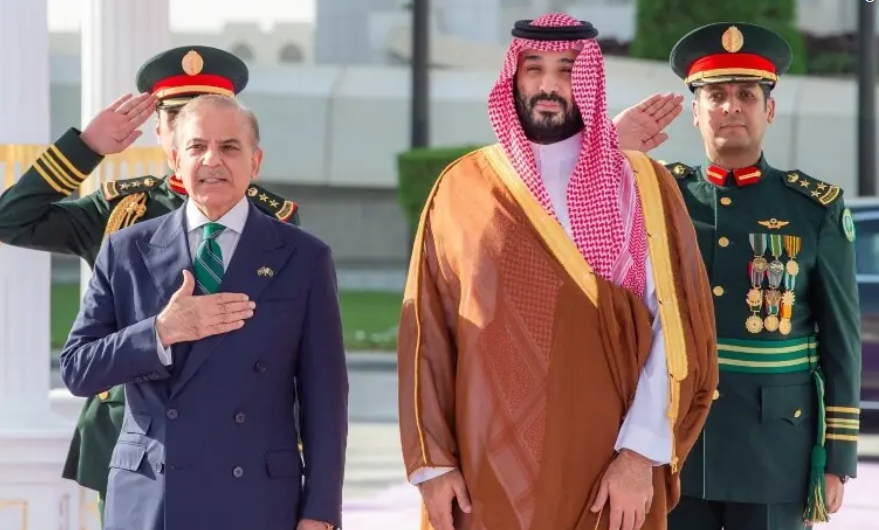
Source: Dawn News
Role of Pakistan’s Military
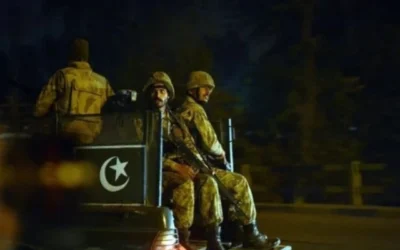
The Pakistan Army played the key role in these developments. The influential Army Chief, Field Marshal Asim Munir, accompanied Prime Minister Sharif through the visit and stood by him during the signing. State TV cameras filmed Sharif and the Crown Prince embracing, with COAS Asim Munir beside them. He played a prominent role in the preparation and completion of this agreement. The agreement itself is based on decades of military cooperation. To train local forces and increase interoperability, Pakistan has long maintained training groups in Saudi Arabia, currently ranging between 1,500 and 2,000 troops to train local forces.
In the joint declarations, the emphasis was placed on this history, with the pact being described as a historic partnership on the basis of the connection of brotherhood and close defense cooperation. Essentially, the deal was influenced by the institutional weight of the Army. It was not only the diplomats but also the armed forces of Pakistan that negotiated the agreement and will implement it. The military leadership of Islamabad was using the pact to put Pakistan forward as a professional and stabilizing force.
Impact on South Asia and the Middle East
The agreement redefines the security of the region. India is keeping a close eye on South Asia. New Delhi said it will examine the implications; however, Saudi officials emphasize that they still have a good relationship with India. Riyadh wants balance, and Pakistani analysts interpret the treaty as defensive, not directed at India, although it might further pressure Kashmir.
The pact expands the security network in the Gulf. Gulf states have already mobilized a GCC defense mechanism in Doha. The Saudi-Pakistan agreement takes it outside the Gulf and directly connects Pakistan to the Arab security. Riyadh is wary about the reliability of the United States as a security guarantor. The Gulf leaders also expect that it will deter competitors such as Iran or Israel. Pakistan has been a source of concern to Washington owing to its missile program, and Islamabad might be forced to assure Washington that the nuclear posture is India-centric.
To Pakistan, the agreement is a strategic win. It brings Saudi Arabia closer to Pakistan’s security, increases its presence in the Islamic world, and increases its bargaining in Gulf decision-making. With mutual defense being codified, the bargaining power and deterrence is acquired by Islamabad. On record, both parties emphasize that the agreement is defensive, and it is designed to deter any aggression.
Joint Statement on the State Visit of Prime Minister of the Islamic Republic of Pakistan, Muhammad Shehbaz Sharif @CMShehbaz , to the Kingdom of Saudi Arabia.
🔗⬇️https://t.co/gG5hJ4Ka7e pic.twitter.com/AXRLnYGVda
— Ministry of Foreign Affairs – Pakistan (@ForeignOfficePk) September 17, 2025
Conclusion
The Saudi-Pakistan mutual-defense agreement is a historic milestone that elevates the status of Islamabad as a Gulf security guarantor. It enhances deterrence and also improves diplomatic status without demanding immediate military intervention. The next strategy that Pakistan needs to adopt is to conduct joint military exercises, intelligence sharing, and the use of clear diplomacy to demonstrate that its deterrent is India-oriented. Simultaneously, it has to address the interests of key players such as the U.S and China. The agreement also provides space to foster Islamic unity and draw Saudi investment and energy cooperation. By transforming decades of cooperation into a treaty, Pakistan will have a long-term cushion and a louder voice in Middle Eastern politics, which will introduce itself as a stabilizing force willing to protect common interests.
You May Like To Read: