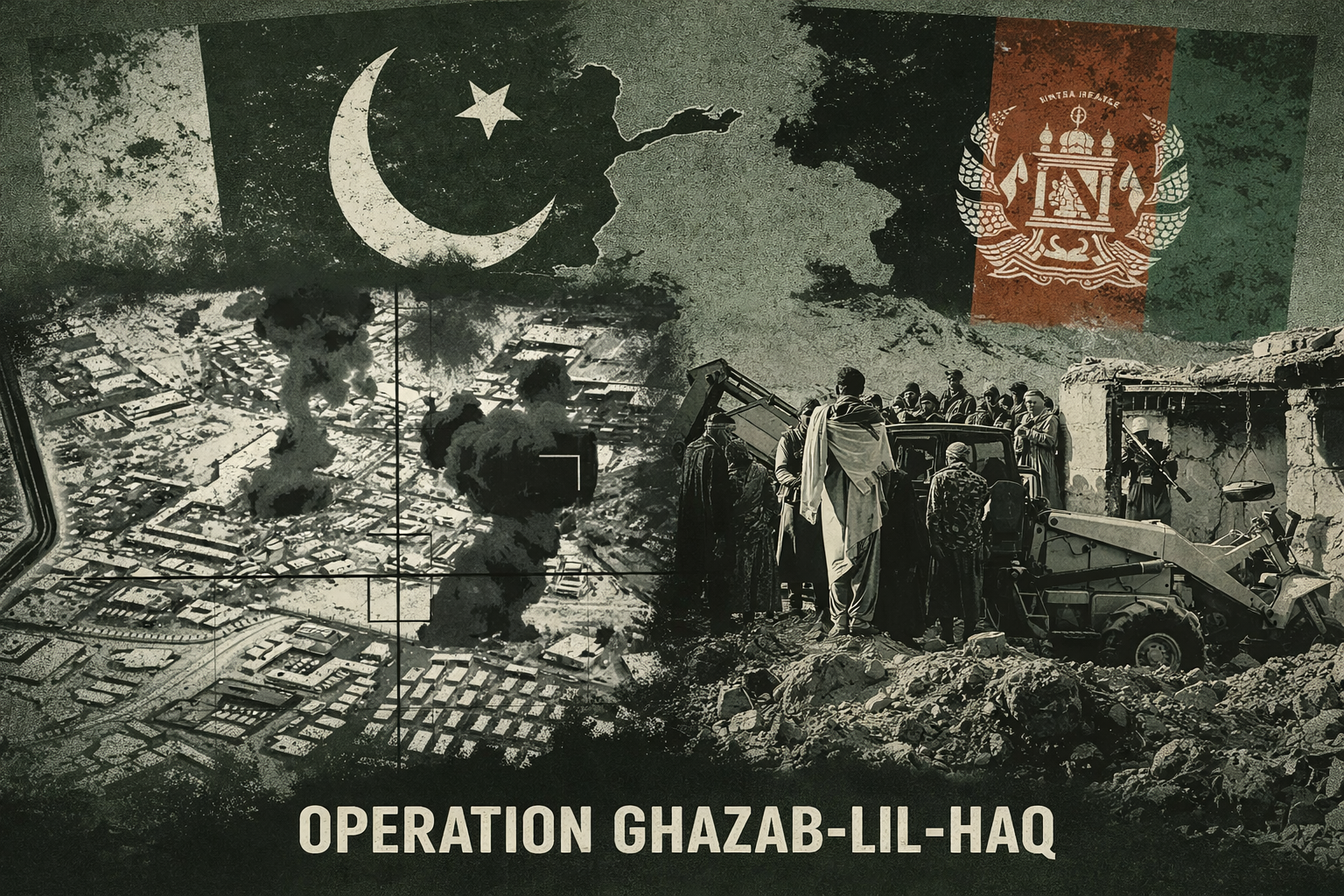
I. The Genesis of the Conflict: Casus Belli
The transition from border skirmishes to a full-scale military campaign, dubbed Operation Ghazab-lil-Haq, was precipitated by a critical breakdown in regional security. Pakistan’s Ministry of Defense has framed this operation not as an act of conquest, but as a necessary surgical response to systemic cross-border threats.
-
The “Unprovoked” Trigger: The immediate catalyst was a heavy exchange of fire initiated by Afghan Taliban forces at approximately 8:00 PM on February 26, 2026. This offensive targeted Pakistani border outposts, forcing a high-intensity retaliatory response.
-
The Sanctuary Ultimatum: For months, Islamabad has provided “actionable intelligence” to Kabul regarding the presence of Tehreek-e-Taliban Pakistan (TTP) and ISKP militants. The February 6 suicide bombing at a mosque in Islamabad, which killed 32 civilians, served as the final breaking point.
-
Diplomatic Exhaustion: Defense Minister Khawaja Asif noted that multiple rounds of talks in Turkey and Qatar failed to produce a commitment from the Taliban to secure their side of the Durand Line. With Ramadan approaching, the military high command opted for a proactive “cleansing” of militant hubs.
II. Timeline and Scale of Deployment
The operation has moved through distinct phases of escalation, evolving from localized strikes into a multi-provincial air and ground assault.
-
Phase 1 (Feb 21 – Feb 25): Precision “Intelligence-Based Strikes” (IBS) targeted hidden training camps in eastern Afghanistan.
-
Phase 2 (Night of Feb 26): Official launch of Operation Ghazab-ul-Haq. This involved the mobilization of the Pakistan Air Force (PAF) and heavy artillery units.
-
Phase 3 (Early Hours, Feb 27): Deep-penetration airstrikes reaching the outskirts of Kabul, aimed at dismantling the Taliban’s centralized military command structure.
Pakistan launched air and ground strikes on Taliban sites across Afghanistan, jolting Kabul residents awake to blasts and gunfire https://t.co/PXpl6BOGST pic.twitter.com/9WXKY8laBF
— Reuters (@Reuters) February 27, 2026
III. Geographical Scope of Operations
The Pakistan Armed Forces have expanded the theater of operations to hit “strategic depths,” ensuring that militant networks have no place to regroup.
-
The Kabul Corridor: Focus on military infrastructure surrounding Kabul International Airport and the secure Pul-e-Charkhi perimeter.
-
The Kandahar Stronghold: Targeted strikes against the political and spiritual HQs of the Taliban leadership.
-
Nangarhar & The Frontier: Tactical ground operations in the Bihsud and Khogyani districts to secure the Khyber Pass.
-
The Southern Belt (Paktika & Khost): Heavy bombardment of the Barmal and Urgun districts to seal TTP infiltration routes.
IV. Strategic Targets & Military Objectives
The mission’s primary objective is the total degradation of the Taliban’s ability to project force across the border and support insurgent proxies.
Military Command & Control
-
Brigade HQs: Direct hits on the 313 Brigade HQ, the 201 KBW Brigade, and the 205 Brigade in Kandahar.
-
Intelligence Infrastructure: Complete destruction of the headquarters belonging to the Taliban’s Intelligence Chief.
Leadership & Logistics
-
High-Value Offices: Surgical strikes on the administrative offices used by Mullah Yaqub, Mullah Anas, and Mullah Nasrullah.
-
Supply Depots: Neutralization of two major corps headquarters and three high-capacity ammunition dumps to limit the Taliban’s “staying power” in a prolonged conflict.
Border Dominance
-
Outpost Neutralization: 27 Taliban border posts were engaged; 9 have been successfully seized and occupied by Pakistani ground forces to create a security buffer.
V. Progress, Achievements, and Losses
As of late afternoon on February 27, the Pakistan military has reported significant tactical gains:
-
Personnel Casualties: * 133 Afghan Taliban (Khwarij) combatants confirmed killed.
-
80 TTP militants eliminated in preliminary strikes.
-
Over 200 combatants wounded and incapacitated.
-
-
Hardware Attrition: * 36 Tanks destroyed.
-
80+ total pieces of heavy equipment neutralized, including artillery and Armored Personnel Carriers (APCs).
-
-
Territorial Gains: Security forces have cleared several “unprovoked firing zones” at the Torkham border, effectively pushing Taliban forces back from the immediate frontier.
VI. Latest Intelligence Update
The situation remains extremely fluid. Defense Minister Khawaja Asif has officially moved the national stance to “Open War,” warning that any further provocation from Kabul will be met with “exponentially greater force.”
Pakistani Defense Minister Khawaja Muhammad Asif said it is “open war” now as Pakistan bombed Taliban government targets in major Afghan cities overnight. https://t.co/qzQpbBoAtH pic.twitter.com/lG6XguVZGl
— DW News (@dwnews) February 27, 2026
Current Situation: Reports from the ground indicate a disorganized retreat by Taliban units from the Torkham sector. Meanwhile, the international community is reacting with alarm. While Russia and regional powers call for a return to the “negotiating table,” the Pakistani leadership has signaled that negotiations are no longer an option until all TTP sanctuaries are demonstrably obliterated.