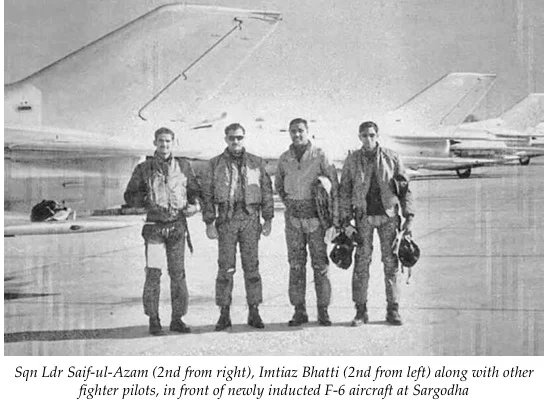
The Pakistan Air Force (PAF) has issued a solemn tribute honoring the extraordinary legacy of Group Captain Saif-ul-Azam, Sitara-e-Jurat (SJ), Sitara-e-Basalat (SBt). Celebrated as a decorated Ghazi of the 1965 Indo-Pak War and a legendary fighter pilot whose achievements transcend international borders, his unmatched skill in aerial warfare remains a source of institutional pride and inspiration.
Originally a Flight Lieutenant deputed to the Royal Jordanian Air Force (RJAF) in late 1966, Saif-ul-Azam flew the Hawker Hunter fighter aircraft with No. 1 Squadron. When the 1967 Arab-Israeli War erupted, he was thrust into intense combat, delivering a masterclass in tactical aviation that secured his unique place in the history of global military aviation.
Today in History
Today we salute the extraordinary feats of Gp Capt Saif-ul-Azam, SJ, SBt; a decorated Ghazi of the 1965 Indo-Pak War and a PAF Shaheen whose legend transcends borders. Then Flt Lt Saif-ul-Azam, on a deputation to Royal Jordanian Air Force in late 1966, flew… pic.twitter.com/zYiAaLsmY9
— DGPR (AIR FORCE) (@DGPR_PAF) June 4, 2026
On June 5, 1967, as Israeli Air Force (IAF) fighter jets launched aggressive strikes to cripple Jordan’s air combat capabilities, Flight Lieutenant Saif-ul-Azam scrambled from Mafraq Air Base into highly contested airspace. Seizing the tactical initiative, he intercepted the incoming strike package, shooting down an IAF Super Mystère and severely damaging another. This decisive action broke the momentum of the Israeli formation, stabilized a chaotic defensive environment, and earned him Jordan’s prestigious military gallantry award, the Wisam-al-Istiqlal.
Two days later, on June 7, 1967, Saif-ul-Azam was again at the leading edge of the conflict. Operating from Iraq’s strategic H-3 airbase sector, he led a formation of Hawker Hunters to intercept an incoming Israeli strike package. Outmaneuvering an IAF Mirage III, Saif-ul-Azam executed a high-G, daring Split-S defensive maneuver to reverse roles and gain a firing solution. Closing the distance with extreme precision, he downed two Israeli aircraft—a Mirage III and a Vautour IIA bomber—in rapid succession. His extraordinary display of tactical flying under severe pressure earned him Iraq’s coveted gallantry medal, the Nawt-al-Shuja’a.
Critical Analysis: Strategic Air Mobility, Transnational Interoperability, and the Unique Military Legacy of Saif-ul-Azam
The historic aerial victories achieved by Group Captain Saif-ul-Azam offer profound insights into air power, tactical execution, and international military diplomacy:
Strategic Impact of Cross-Theater Deputations
Saif-ul-Azam’s actions highlight the massive strategic value of the Pakistan Air Force’s historic international deputation programs. During the 1960s and 1970s, Pakistan actively deployed its highly trained fighter pilots and technical staff to strengthen the air defense commands of several Middle Eastern and Arab countries, including Jordan, Iraq, Saudi Arabia, and Syria.
This policy went far beyond standard military diplomacy; it established a highly capable framework for transnational interoperability. By placing battle-hardened pilots from the 1965 Indo-Pak War directly into the front lines of allied air forces, Pakistan provided vital tactical expertise to partner nations during critical regional crises, elevating its geopolitical standing across the Muslim world.
Tactical Domination of the Hawker Hunter Over Supersonic Adversaries
From a technical and aviation perspective, Saif-ul-Azam’s aerial victories are remarkable because of the aircraft platforms involved. The British-built Hawker Hunter was a subsonic fighter, meaning it could not fly faster than the speed of sound. In contrast, the Israeli Air Force deployed the French-built Mirage III, a state-of-the-art, delta-wing supersonic interceptor capable of reaching Mach 2.
By using aggressive close-quarters maneuvering and executing a high-risk Split-S maneuver to drop altitude rapidly and get behind the faster Mirage, Saif-ul-Azam proved that pilot capability, situational awareness, and mastery of energy management can overcome a significant technological disadvantage. His success showed the global aviation community that a subsonic platform, when flown by an exceptional pilot, could still defeat advanced supersonic fighters in a dogfight.
A Unique Diplomatic Distinction in Global Military Aviation History
Group Captain Saif-ul-Azam holds a unique and unparalleled record in the history of international air warfare. He remains the only fighter pilot in the world to have served actively in three different air forces (Pakistan, Jordan, and Iraq) and to have shot down enemy aircraft from two different opposing air forces (India and Israel).
By earning top gallantry awards from three separate sovereign nations—the Sitara-e-Jurat from Pakistan, the Wisam-al-Istiqlal from Jordan, and the Nawt-al-Shuja’a from Iraq—Saif-ul-Azam’s career stands as a rare historical example of a single pilot becoming a national hero across multiple, diverse countries simultaneously.
Direct Contribution to Regional Stability and Force Preservation
The tactical significance of Saif-ul-Azam’s interceptions on June 5 and June 7 went beyond adding to his personal kill score; his actions directly preserved allied military infrastructure. During the opening hours of the 1967 war, the Israeli Air Force launched Operation Focus, a highly successful pre-emptive strike that destroyed most of the Egyptian air force on the ground.
When the IAF turned its attention east to target Jordan and Iraq, the air bases at Mafraq and H-3 were in imminent danger of being completely destroyed. Saif-ul-Azam’s aggressive, immediate counter-attacks disrupted the timing and precision of the Israeli bombing runs. By forcing the attackers to jettison their payloads early to defend against his Hawker Hunter, he saved critical runway infrastructure and aircraft, allowing allied regional forces to maintain a defensive posture.