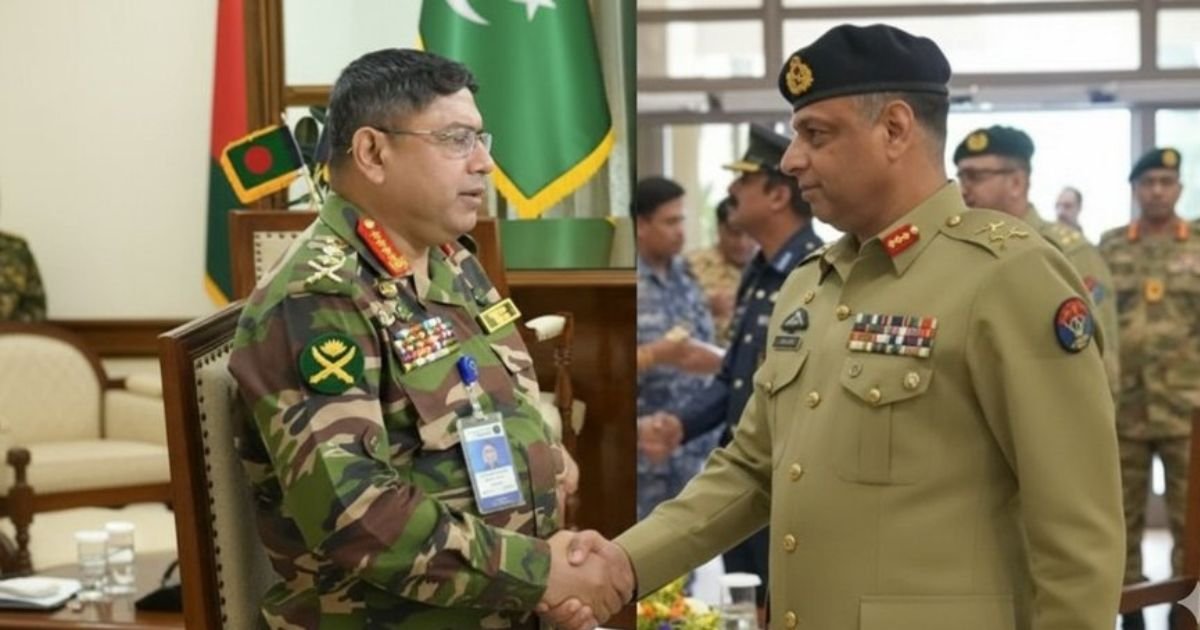
Dhaka, 6 October 2025 — Lieutenant General Tabassum Habib, Director General of Joint Staff (DGJS) of the Pakistan Army, arrived in Dhaka on 6 October for a four-day official visit. The engagement marks the highest-level Pakistani military visit to Bangladesh since the interim government led by Chief Adviser Muhammad Yunus took office in August 2024, and is viewed as a significant development in Pakistan–Bangladesh defence relations.
#BREAKING: First ever Pakiatani military delegation, including Pakistan Air Force officials, has landed in Bangladesh. pic.twitter.com/BwmUDr8nQh
— Ironclad (@NavCom24) October 6, 2025
Delegation and Host
Lt Gen Tabassum Habib leads Pakistan’s Joint Staff Branch, which oversees inter-service coordination across the Army, Navy, and Air Force. He also heads the Special Investment Facilitation Council (SIFC), a key civil-military body responsible for streamlining national investment strategies.
A four-member delegation, including a Pakistan Navy commodore and a staff officer of the rank of major, accompanied him. The visit is hosted by Bangladesh’s Armed Forces Division (AFD) under the Office of the Chief Adviser. The AFD is headed by Lieutenant General S M Kamrul Hassan, who visited Rawalpindi earlier this year.
Tentative Schedule and Engagements
According to official sources, the visit is structured to include several high-level meetings and ceremonial engagements:
- 7 October: Lt Gen Habib is expected to receive a Guard of Honour at Sena Kunjo. His programme includes formal meetings with senior Bangladeshi defence officials, including Lt Gen S M Kamrul Hassan at the AFD complex, and a one-on-one discussion with General Waker-uz-Zaman, Chief of Army Staff of the Bangladesh Army. He is also scheduled to visit the Bangladesh Air Force and Navy Headquarters for working lunch and dinner engagements.
- 8 October: He is expected to deliver remarks at the National Defence College (NDC) in Mirpur. Later, he is likely to travel to Cox’s Bazar to visit the 10th Infantry Division Headquarters at Ramu, a strategically important formation responsible for the protection of Bangladesh’s southeastern frontier. A formal dinner hosted by the Bangladesh Army is also on the programme.
- 9 October: The delegation is expected to return to Islamabad, concluding the four-day visit.
You May Like To Read: DG ISPR: Chinese Weapons Performed “Exceptionally Well” Against India in May Conflict
Strategic Significance
The visit represents a notable revival of defence-to-defence engagement between Pakistan and Bangladesh after years of limited direct interaction. It reflects Dhaka’s growing intent to diversify its defence partnerships beyond traditional allies such as India and China, by engaging with regional actors like Pakistan on a professional and non-political basis.
Although officially described as a “goodwill mission,” the timing and level of the visit indicate broader strategic calculations. Dhaka is signalling a more balanced regional posture, while Islamabad views the visit as an opportunity to re-establish ties with a key South Asian neighbour.
Analysts emphasize that the renewed interaction focuses on practical cooperation rather than ideological alignment, covering areas such as defence education, operational dialogue, and knowledge exchange. The visit also fits into a broader pattern of quiet military-level exchanges observed throughout 2025, including earlier visits by Pakistani intelligence and military officers.
Profile of the Visiting General
Lt Gen Tabassum Habib was commissioned into the Corps of Artillery in 1991 and has held several important command and staff appointments, including command of the 14th Infantry Division at Okara. He holds an MPhil in Public Policy and Strategic Security, a master’s degree in Defence Studies from King’s College London, and has completed executive education at Harvard Kennedy School. He was promoted to lieutenant general in late 2024 and appointed DGJS soon afterward.
While no formal agreements are expected to be announced during this visit, the engagements are seen as laying the groundwork for renewed professional cooperation. For Bangladesh, this represents a carefully calibrated strategic move. For Pakistan, it offers a channel to revive military ties after a prolonged period of political distance.
Observers note that the future trajectory of this renewed interaction will depend on sustained follow-up, mutual confidence, and strategic alignment amid an evolving South Asian security environment.
You May Like To Read: Lieutenant General Muhammad Asim Malik to Continue as DG ISI and NSA