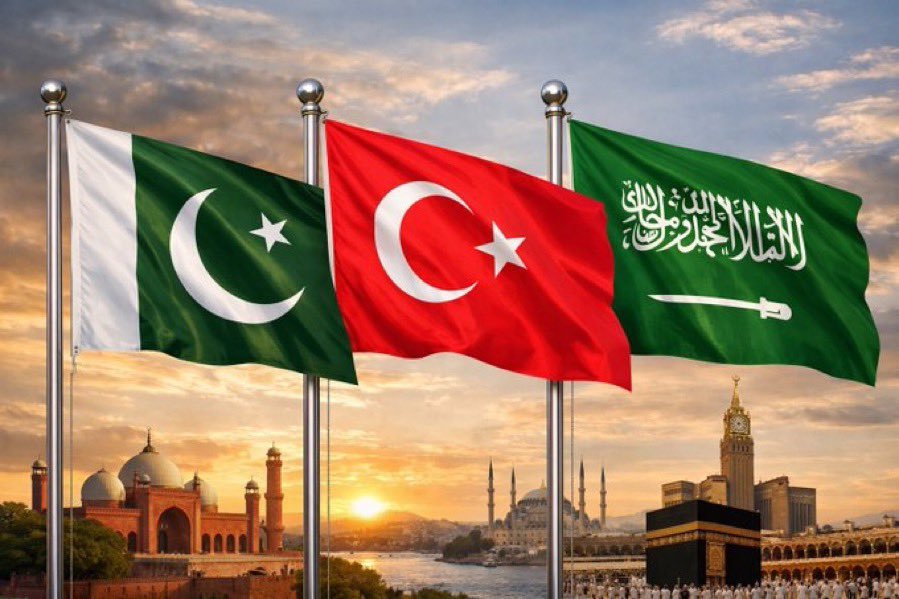
Recent reports confirm that Ankara is in advanced talks to join the Saudi-Pakistan Strategic Mutual Defense Pact. Signed in September 2025 by PM Shehbaz Sharif and Crown Prince MBS, the pact treats any attack on either signatory as an attack on both. A Turkish accession would respond to shifting geostrategic realignments. As analysts note, Turkey’s interests in South Asia, the Middle East, and even Africa are converging with those of Pakistan and Saudi Arabia. All three governments share close military ties (joint exercises, training, and arms projects) and currently question the credibility of Western security guarantees. In this context, Muslim-majority states are actively exploring indigenous security arrangements, sometimes termed an “Islamic NATO,” to provide collective defense beyond the reach of outside powers.
🚨 🇹🇷🇸🇦🇵🇰 BREAKING: Turkey is reportedly seeking to join the Saudi Pakistan Defence Pact, a mutual defense arrangement in which an attack on one member would be treated as an attack on all, according to Bloomberg.
If finalized, the move would mark a major strategic shift,… pic.twitter.com/2WrzlW7a3J
— Defence Index (@Defence_Index) January 9, 2026
Strategic Factors Fostering the Trilateral Pact
Several strategic drivers underpin this move. First, shifts in great-power dynamics have eroded trust in traditional patrons. U.S. policy fluctuations in the Middle East and South Asia alike have left Riyadh, Islamabad, and Ankara seeking more reliable regional bonds. For example, analysts note that concerns about the U.S. commitment to the North Atlantic Treaty Organization (NATO) and the U.S. shifting priorities in the Gulf region have encouraged Turkey to modernize its security relationships. Second, new threats have emerged. The recent outbreak of violence in Gaza and the Middle East, along with rising tensions between India and Pakistan, again underscores mutual vulnerabilities. Saudi decision-makers, for example, see value in Pakistan’s deterrent against aggressive Israeli actions and Iranian challenges. Third, Pan-Islamic solidarity is a political factor. Muslim elites have long debated the need to establish an inter-state defense forum (“Islamic NATO”) to safeguard the umma. The Saudi-Pak pact itself has been framed by some as a first step toward this vision. In short, regional balance-of-power dynamics – U.S. unreliability, the rise of multipolarity, and common security threats, encourage a coordinated Turkey-Pakistan-Saudi axis that advances strategic autonomy for the Islamic world.
Complementary Strengths of the Alliance
Each member brings distinct capabilities, making the three strategically complementary. Pakistan brings its nuclear deterrent and one of the most experienced militaries in the region. Islamabad has sophisticated ballistic missiles and about half a million troops, and its armed forces have extensive combat and counter-threat experience. Pakistan’s geography further amplifies its role; it lies at the nexus of South Asia, the Gulf, Central Asia, and China’s Belt and Road routes, bridging many theaters of concern. Turkey adds NATO-level military expertise and technology. Ankara’s forces are battle-hardened from operations in Syria, Libya, and elsewhere, and the country’s defense industry now manufactures everything from Bayraktar drones to fighter jets. With the second-largest army in the North Atlantic Treaty Organization after the U.S., Turkey also brings large-scale logistics and organization. Saudi Arabia provides the alliance with financial and economic depth. Riyadh’s oil wealth and investments provide fuel, funding, and infrastructure for any joint defense efforts, and its diplomatic clout helps rally Islamic world opinion. Altogether, Pakistan’s nuclear umbrella and manpower, Turkey’s military power honed by its membership in the North Atlantic Treaty Organization, and Saudi Arabia’s financial muscle create a strong, collective arsenal. Together, these assets multiply deterrence: an aggressor would face not only one but a tri-country response supported by missiles, air, and naval power and deep resources.
Collectively, the trilateral pact serves as an effective means of increasing deterrence in terms of depth and breadth. Article-5-type commitment means that attackers must reckon with the nuclear shield of Pakistan and Turkey’s ability to respond on the scale of a European nation’s military. From Saudi Arabia’s perspective, this is a form of “double deterrence” strategy: Riyadh may lean on both U.S. ties and a new local guarantor. Indeed, officials from Saudi Arabia and Pakistan have signaled that Islamabad’s nuclear program could be made available to Riyadh if needed. This forms an effective dissuasive umbrella: any foe that thinks of causing harm will now face the Muslim world united and a credible strike force.
Breaking News 🇵🇰🇸🇦🇹🇷⚡:
According to Bloomberg Turkey is seeking to join the defense alliance between Saudi Arabia and nuclear-armed Pakistan, according to people familiar with the matter, paving the way for a new security alignment that could shift the balance of power in the… pic.twitter.com/QgImYwTpl2— Pakistan Defence🇵🇰 (@PakDefence_) January 9, 2026
Collective Autonomy and Less Western Dependence
The proposed bloc would be a major move toward Muslim self-reliance in defense. Western security assurances are increasingly viewed as conditional and interest-based. As one analysis notes, recent events (e.g., limited U.S. action after Middle East attacks) have led Gulf leaders to openly discuss “intra-regional” defense ties. In this light, a Turkey, Saudi Arabia, and Pakistan alliance diversifies security arrangements outside American or Western Atlantic umbrellas. It sends a signal to all that Muslim states can stand on their own terms. The alliance would also grant strategic autonomy: it enables each member to act without waiting for distant powers. For example, in a crisis, Ankara or Riyadh could call on Pakistan’s deterrent, directly and vice versa, while pooling intel and logistics. This is a natural outgrowth of a larger trend, Islamic-world leaders discussing an “Islamic NATO” framework to ensure collective defense. The trilateral pact represents a south-south security architecture, minimizing the strategic gap left by any wavering by Western partners.
Implications for Pakistan Leadership in the Muslim World
For Islamabad, this evolving axis would ensure Pakistan’s position as a military and diplomatic leader among Muslim nations. The 2025 Saudi pact already “signaled an elevation of status” for Pakistan, affirming its return as a co-shaper of the Gulf’s security and not merely a manpower-providing nation. Adding Turkey would only strengthen this perception. Pakistan’s credentials, as the Islamic world’s only nuclear power, with an impressive army and large expatriate communities in the Gulf, make it the natural security pivot. In practice, Pakistan can use the trilateral framework to take a leadership role in joint training, technology sharing, and coordinated policy in forums such as the OIC. Analysts even foresee Iran or other Muslim states eventually associating with this framework, under the Pakistani umbrella.
Ultimately, the pact would strengthen Pakistan’s diplomatic position. It places Islamabad in the role of a central broker, positioned to mediate between the Gulf monarchies and South Asia. This could empower Pakistan to promote a new collective-security agenda (for example, at OIC summits) that speaks for the “Global South” of Muslim states. And in shouldering the burdens of regional security, Pakistan secures international prestige and influence. While challenges remain (Pakistan will need to balance its relations with Iran and India carefully), the net effect is likely to be a positive one: a stronger deterrent bloc around the leadership of Islamabad, thereby reducing the risks to all members. In sum, Turkey’s joining of the Saudi-Pakistani alliance might represent an important turning point in the evolution of a more coherent Muslim security architecture, where Pakistan would be at the center of collective deterrence and regional stability.