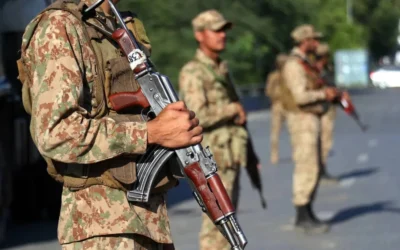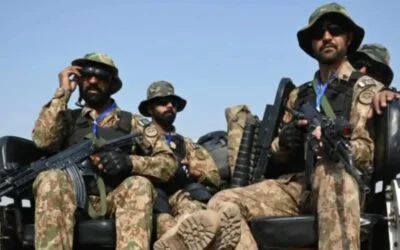
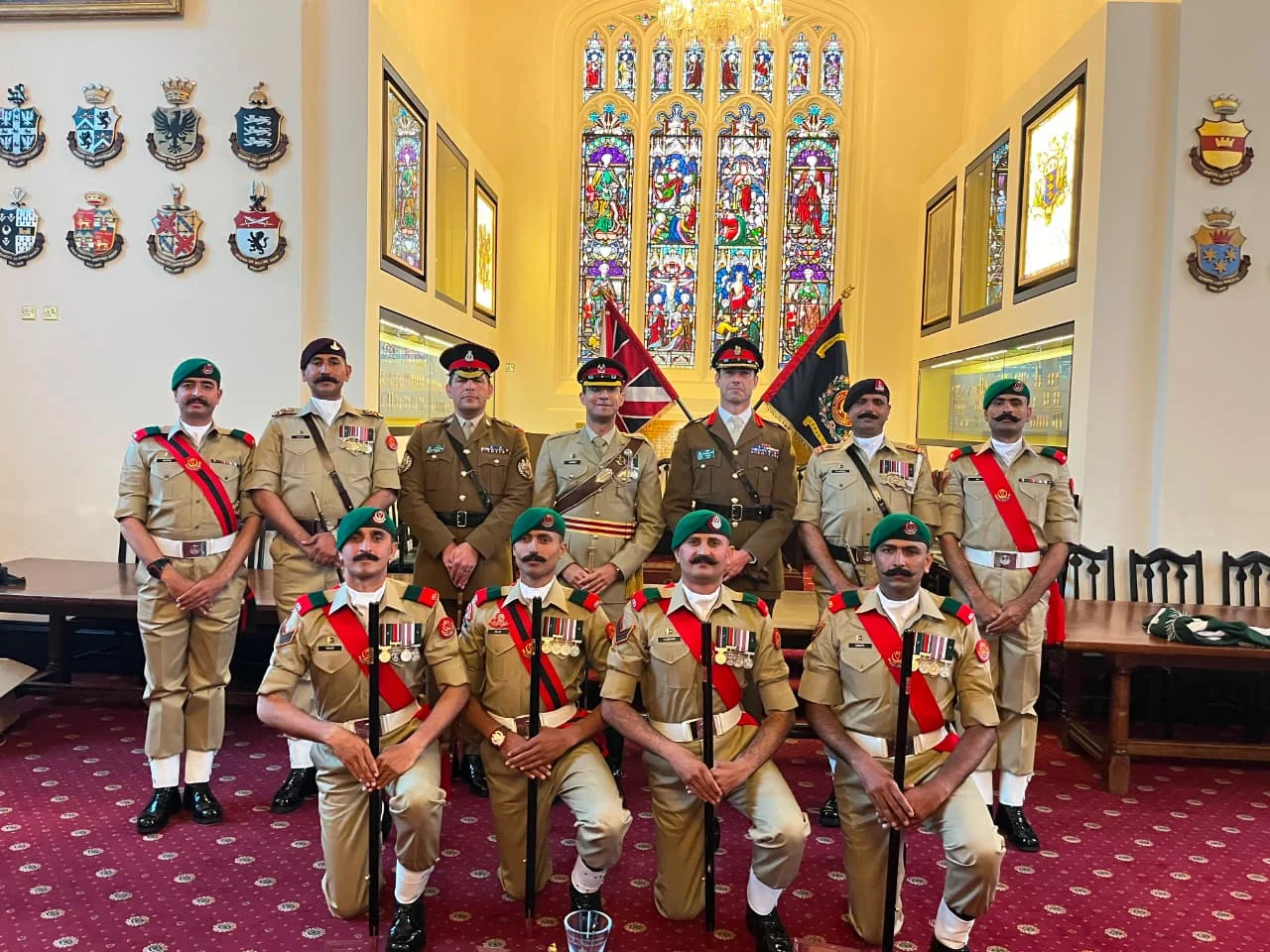
In a flawless exhibition of synchronized discipline and battlefield precision, the Pakistan Army team has secured first place at the prestigious International Pace Sticking Competition 2026, held at the Royal Military Academy (RMA) Sandhurst, United Kingdom.
According to a formal statement issued by the Inter-Services Public Relations (ISPR) on Friday, the contingent—solely represented by cadets and drill instructors from the Pakistan Military Academy (PMA)—achieved a comprehensive “clean sweep” of the tournament, taking home every premier accolade on the parade square.
Pakistan wins 1st Position at the prestigious International Pace-sticking Competition 2026 held at the Royal Military Academy (RMA) Sandhurst, United Kingdom. The Pakistan Army team was represented by the Pakistan Military Academy (PMA). pic.twitter.com/E3wOb1cvbd
— The STRATCOM Bureau (@OSPSF) June 12, 2026
1. Total Dominance on the Sandhurst Square
Led by PMA Adjutant Major Haider Gulzar, the nine-member Pakistani delegation arrived in the UK on June 5, facing intense pressure in a field featuring 16 elite international military teams. Despite the fierce global competition, the PMA squad systematically locked down top honors:
-
1st Overall Team Trophy (International Category)
-
Best Pace Sticker Award
-
Best Driver Award (The lead pace-stick operator who sets the cadence and uniform stride length for the team)
This victory marks a continuing legacy of dominance at Sandhurst. Pakistan previously claimed a historic three-peat at the competition between 2018 and 2020. The victory also mirrors the army’s tactical achievements in field craft, following consecutive gold medals at the grueling Exercise Cambrian Patrol in Wales in late 2024 and October 2025.
[2024: Cambrian Patrol Gold] ➔ [2025: Cambrian Patrol Gold] ➔ [2026: Sandhurst Pace Sticking 1st Place]
2. The Mechanics of the Pace Stick
Originating as a historical tool used by the Roman army to measure marching distances while paving military roads, the modern pace stick is an iconic mechanical aid. Alongside the drum and metronome, it is used by drill instructors to enforce mathematical uniformity in stride length, cadence, and posture.
Competing teams must execute complex maneuvering sequences at both slow and quick time, flawlessly turning and alternating the stick between the left and right hands under the microscopic scrutiny of royal adjudicators.
CRITICAL ANALYSIS: THE STRATEGIC SYMBOLISM OF DRILL EXCELLENCE
While casual observers often dismiss ceremonial drill as an archaic relic of 19th-century warfare, a critical defense analysis reveals that success at Sandhurst serves as a vital component of a nation’s conventional deterrence and strategic projection.
The Psychology of Synchronicity
In military science, the precision required to execute a flawless pace-stick routine is directly linked to the psychological foundations of combat discipline. A “clean sweep” at an international venue like Sandhurst demonstrates an elite level of small-unit cohesion, institutional obedience, and meticulous attention to detail.
For the Pakistan Military Academy, out-marching 15 peer international militaries on the historical parade ground of their former colonial trainers is a potent manifestation of organizational health. It sends a clear signal to regional observers: the foundational training pipeline responsible for grooming Pakistan’s future frontline officers remains fundamentally unbroken and operating at world-class standards.
[Rigorous Drill Discipline] ➔ [Flawless Small-Unit Cohesion] ➔ [High-Stress Combat Operational Success]
Soft Power Amid Asymmetric Friction
Furthermore, this victory serves as an essential soft-power balancing mechanism. At a time when Pakistan’s armed forces are heavily committed to complex internal security operations, managing border friction, and navigating high-stakes regional diplomacy in the Persian Gulf, symmetric victories on the international stage are invaluable.
By consistently securing top positions at both the Cambrian Patrol (the Olympics of military patrolling) and the Sandhurst Pace Sticking Championship, the Pakistan Army effectively counters negative narratives, proving its institutional versatility. It demonstrates that the force can simultaneously manage high-intensity asymmetric warfare at home while outperforming Western and regional peers in the classical, rigid disciplines of conventional military professionalism abroad.
The Takeaway: The PMA’s clean sweep at Sandhurst is not merely a triumph of choreography; it is a validation of the army’s training doctrine. In an era where modern warfare is increasingly chaotic and decentralized, Pakistan’s absolute mastery over the basic building blocks of military discipline—steadiness, uniformity, and mechanical precision—reaffirms its status as one of the most formidable and highly trained fighting forces in the international arena.