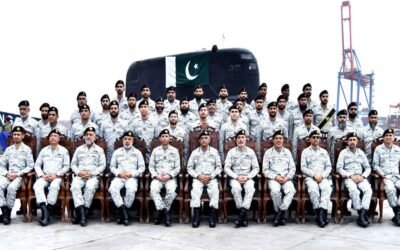
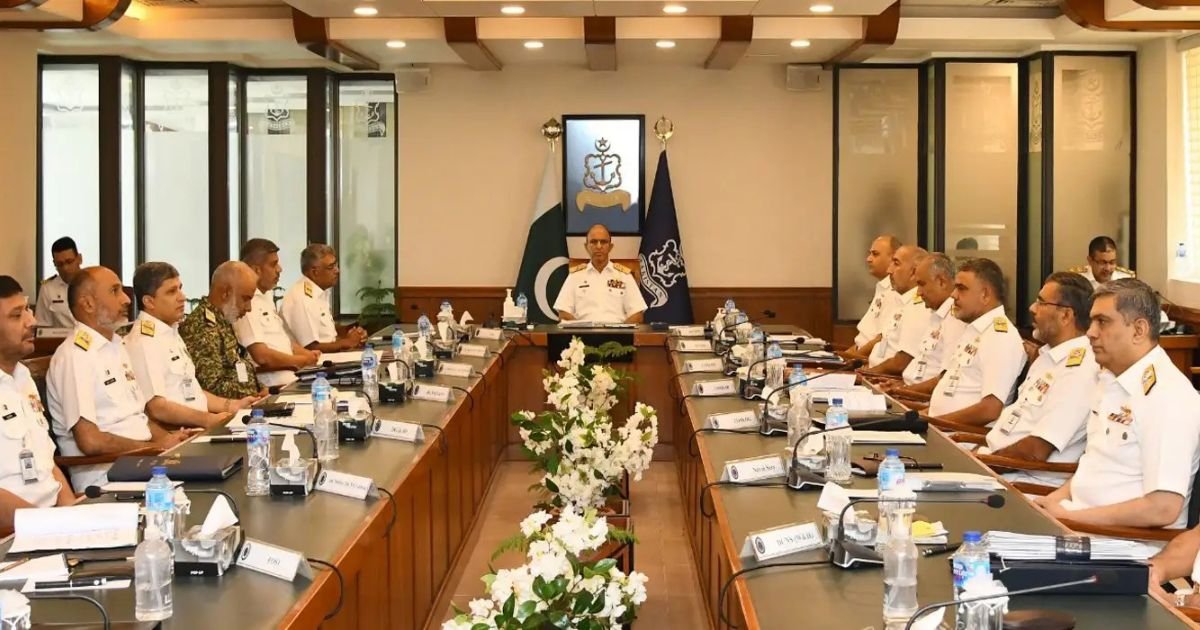
The Command and Staff Conference of Pakistan Navy was concluded at the Naval Headquarters, Islamabad, on the 29th of October, 2025. The meeting, which was chaired by Chief of Naval Staff Admiral Naveed Ashraf, discussed the strategic posture of the navy and operational plans of the navy. Ashraf emphasized the necessity of constant combat readiness and noted that the Navy is “fully prepared to safeguard national sovereignty and defend every inch of the country’s maritime frontiers”. As the highest-level naval meeting in Pakistan, the conference was convened to bring together key staff and field commanders to synchronize the naval doctrine and capabilities with the emerging security issues.
Command & Staff Conference of #PakNavy concluded at NHQ Islamabad, chaired by CNS Adm Naveed Ashraf. The forum reviewed operational preparedness, ongoing initiatives & PIMEC-25 preparations, reaffirming PN’s unwavering resolve for maritime security & national defence. pic.twitter.com/3KMzV9oL9y
— DGPR (Navy) (@dgprPaknavy) October 29, 2025
Strategic Agenda and Deliberations
The agenda in the conference was concerned with review of doctrine, operational planning, lessons learned, and force modernization priorities. ISPR also states that the participants have conducted an in-depth examination of the operational preparedness, current projects, and future activities, as well as preparations that will be conducted during the Pakistan International Maritime Expo and Conference (PIMEC). These reviews facilitate the transformation of strategic priorities into action plans. According to the PN spokespersons, the forum has served as an opportunity for a detailed review of operational preparedness, fleet modernization, and technological developments to ensure that the naval policy is in tandem with the national security goals.
Admiral Ashraf, in his speech, emphasized recent achievements of modernization. He has mentioned new Chinese-built platforms such as Hangor-class attack submarine and Type 054A/P multi-role frigates as force multipliers. He observed that these advanced frigates and attack submarines have empowered the operations of the Pakistan Navy by expanding its range of operations, multi-domain warfighting, and deterrence posture. The presentation of these assets in the sea promotes credible deterrence in the Arabian Sea by the navy. Another important point Ashraf made was the necessity to use the latest technologies (unmanned systems, AI) to be prepared for the future.
The C&SC discussed current and planned exercises. Individuals assessed lessons of recent multilateral drills (e.g., AMAN-2025 in the Arabian Sea) and optimized the operational concepts correspondingly. Another line of improvement that was to be made in the forum was training, both on-sea and on-shore, to recalibrate the sailors’ skills. Naval leadership focused on the integration of joint forces, the sharing of intelligence, and enhancing command and control.
Impact on Maritime Strategy and Coastal Security
The outcomes of the conference will impact Pakistan’s maritime strategy and coastal security posture. Improved naval preparedness contributes to the plausible deterring action towards external aggression and non-traditional issues (terrorism, piracy) as well. Admiral Ashraf highlighted the importance of the Navy in ensuring seaward approaches and pointed out that trade lanes in the Arabian Sea are strategic assets of Pakistan since the country is strategically positioned. He emphasized the role of the PN in “safeguarding trade routes and the nation’s economic interests in the Arabian Sea”, which forms the basis of stability in the region.
The Navy aims to prevent aggression along the coast of Pakistan by reasserting an unswerving commitment to maritime security and national defense. According to the DGPR (Navy), this resolve was reiterated during the conference, which examined readiness, current initiatives, and PIMEC preparations. Strategically, a battle-ready navy will assist Pakistan in its pursuit to impose its influence in the broader Indian Ocean. Recent modernizations (long-range sensors, new frigates, and subs) push the range of operations of Pakistan even deeper into open water. These systems are now used to provide maritime security in the North Arabian Sea and the rest of the Indian Ocean zone, which is of significant global economic concern as framed by the Pakistan Navy. The logistics and posture of the naval force in Pakistan (e.g., fleet tankers) are being intensified to defend the coastal installations, CPEC sea lanes, and overseas sea lines of communications.
Demonstrating Readiness: Exercises, Upgrades, Training
The conference highlighted specific actions that demonstrate the Navy’s preparedness. Admiral Ashraf mentioned new acquisition programs and exercises as a sign of progress. According to Admiral Naveed Ashraf, the navy is set to commission its first Hangor-class Chinese-built submarine by 2026, as part of an 8-boat program with technology transfer. He also added that the new Type 054A/P frigates currently in service have significantly enhanced the multi-mission capabilities of the navy, particularly in the area of air defense, anti-submarine combat, and marine surveillance. These advanced platforms will improve the endurance of patrols and anti-surface capabilities, essential to sea control.
Training programs are also being refined. Delegates at the conference supported expansion of high-technology war training, such as live-firing exercises and anti-submarine maneuvers, as well as joint operations with other military forces. Ashraf emphasized that continuous combined drills, especially with China, have created interoperability. He noted that professional synergy and a common strategic perspective are enhanced through joint training and exercises. Special training simulators and academies in the country continue to produce competent officers and sailors. The leaders of the navy underline that active training cycles are the core of the mission, safeguarding national interests and keeping crews competent in various situations.
The Command & Staff Conference of Pakistan Navy concluded at Naval Headquarters, Islamabad. The conference was chaired by Admiral Naveed Ashraf, NI, NI (M), Chief of the Naval Staff.
During the conference, Chief of the Naval Staff emphasized on the significance of sustaining… pic.twitter.com/e4SmGFtGQA
— PTV News (@PTVNewsOfficial) October 29, 2025
Conclusion
The Pakistan Navy will report on these deliberations at the conference in the future. Senior officers will implement the described modernization roadmap, and training cycles will be optimized. The Pakistan International Maritime Expo and Conference (PIMEC-25) will serve as a milestone to demonstrate these steps. Overall, the C&SC reiterated that the Navy was firmly dedicated to national interests. According to ISPR, the conference ended with a reaffirmation of the need to protect the seas of Pakistan and to work towards stability in the region. With a dynamic regional environment, the naval command of Pakistan has indicated that vigilance and development in the sea will persist.