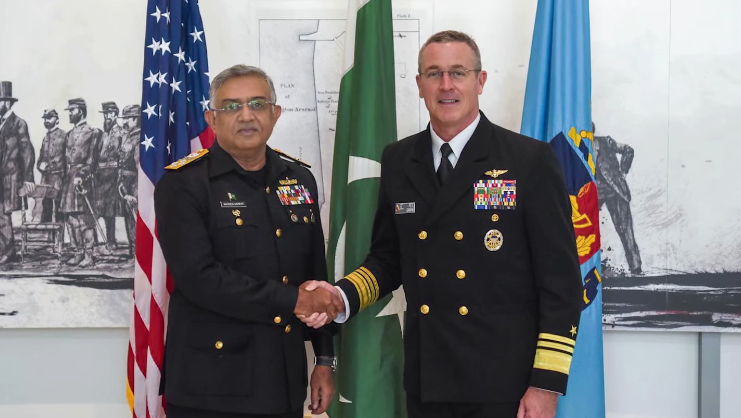
Admiral Naveed Ashraf, the Chief of Naval Staff of Pakistan, concluded the visit to the United States on 17 October 2025. The Navy chief had a meeting with the senior U.S. maritime and defense officials to enhance bilateral maritime relations and defense-related engagements. Admiral Ashraf in Washington was engaged in a meeting with the U.S. Deputy Chief of Naval Operations Vice Adm. Yvette Davads, as well as United States Coast Guard Acting Vice Commandant Vice Adm. Thomas Allan.
CNS Adm Naveed Ashraf visited the United States and held meetings with senior naval, coast guard, and state officials. Discussions focused on maritime cooperation, regional security, and defence engagement reflecting strong Pak US naval ties. pic.twitter.com/RNnbttCgI6
— DGPR (Navy) (@dgprPaknavy) October 16, 2025
He also visited the National Defense University, where he met its President, Vice Adm. Peter Garvin, and visited Stanley Brown, who was the Deputy Assistant Secretary of State, Political-Military Affairs. Themes of professional exchanges, regional security dynamics, and capacity-building were discussed within the maritime domain. The chief of the Pakistan Navy also addressed U.S. scholars and think tank experts on the challenges of regional maritime security, emphasizing the role of Pakistan’s cooperation in security matters.
Islamabad presented the visit as a renewal of long-standing relationships. The meetings were characterized by discussions on politico-military cooperation, maritime security, capacity-building efforts, and shared maritime interests. Both parties had been very determined to facilitate naval security. The visit is a continued effort to enhance bilateral cooperation between the two navies in the area of naval cooperation. In fact, the trip institutionalized training and engagement strategies, such as Pakistan’s commitment to remain involved in joint naval drills and professional exchange, but no concrete agreements were released.
چیف آف دی نیول اسٹاف ایڈمرل نوید اشرف کا امریکہ کا دورہ
سربراہ پاک بحریہ کی امریکہ کی اعلیٰ بحری اور سول قیادت سے اہم ملاقاتیں
نیول چیف کی امریکی ڈپٹی چیف آف دی نیول اسٹاف آپریشنز اور کوسٹ گارڈ کے وائس کمانڈنٹ سے الگ الگ ملاقاتیں
نیول چیف نے امریکہ کی نیشنل ڈیفنس یونیورسٹی کا… pic.twitter.com/rCPOJOZXtg
— PTV News (@PTVNewsOfficial) October 17, 2025
Pakistan Navy Modernization
The modernization of the Pakistan Navy has been proceeding very fast over the last few years. It has a balanced fleet of frigates, corvettes, missile craft, and support vessels, and a strong submarine fleet. Pakistan Navy is modernizing with the induction of Chinese-made Hangor-class diesel-electric submarines, PNS/M SHUSHUK, and the Turkish-designed MILGEM corvettes. The new submarines and corvettes can patrol the coast of India and ensure the safety of sea routes, and drone and helicopter upgrades can enhance their 24/7 awareness in the maritime domain. A modernized Pakistani fleet, in any Pakistan-India sea crisis, would provide the capability to more effectively deter blockades or interdict shipping at the Arabian Sea, and could also help provide littoral defense of the Pakistan coast approaches.
This trip to the U.S in October 2025 followed a two-day port call of USS Wayne E. Meyer at Karachi (Sept. 24-26, 2025). The Wayne E. Meyer tour enhanced the long-standing maritime partnership between the U.S. Navy and the Pakistan Navy. At that port call, the crew of the ship and Pakistani sailors took part in training activities, sports activities, and cross-deck visits. These are tangible evidence of interpersonal and professional relationships being strengthened by practice. The best practices were exchanged between Pakistani and U.S officers in navigation and engineering, and the top commanders were also exchanging gifts aboard the ship, which highlighted the increasing levels of trust and interoperability.

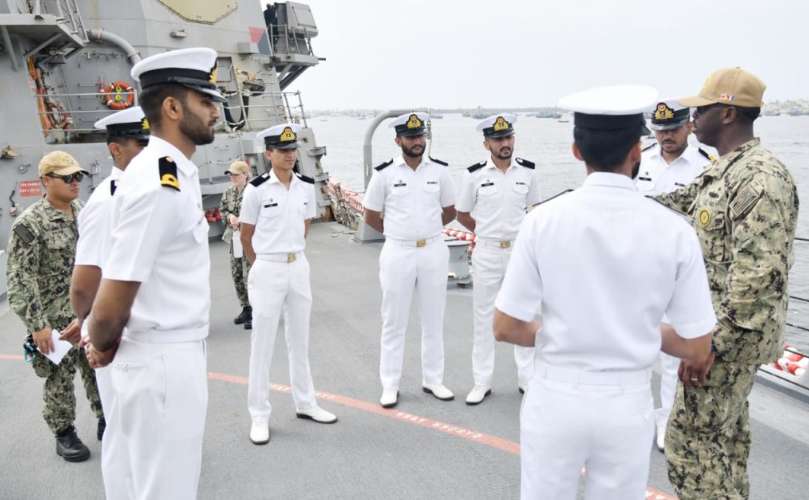
In September 2025, the crew participated in professional exchanges, training, and sports activities during the US Ship Wayne E Meyer’s visit to Pakistan.
Source: APP News
These activities on the ground are complementary to formal exercises. As an example, in April-May 2024, the two navies hosted the four-day bilateral exercise called Inspired Union 2024 in Karachi. That exercise led by the U.S. centered on maritime interdiction, mine countermeasures, and port security. These are essential capabilities for a significant transit hub. These drills, such as Inspired Union, are still enhancing the preparedness and interoperability in the ocean area and boosting the free flow of commerce in strategically essential waters. The Pakistan visit and recent drills are indicators of an increased presence of U.S.-Pakistan collaboration at sea. The level of training exchange between navies and even coastal defense has now become a two-way flow. The Pakistan Navy has also recently sent officers to train with the U.S. Coast Guard and the Naval Forces Central Command, with an extension of joint capacity-building.
A combination of these events indicates increased collaboration. Following high-tech drone exchanges with India, the Naval Chief of Pakistan has publicly focused on domestic drone development and collaborative air-naval drills. The U.S and Pakistani warships may expand logistics relationships. The Meyer visit shows that U.S ships can conduct operations out of Pakistani ports upon coordination.
You May Like To Read: Coastal Exercises of Pakistan Navy near Sir Creek: Meaning and Strategic Indication
Strategic Implications
The U.S. visit by this naval chief should be viewed within the wider geopolitical context. Formal statements emphasize the overlapping of the interest in maritime security and stability in the region. To the U.S., the involvement of the Pakistani navy serves to ensure that major sea routes in the Indian Ocean remain open and to counter any threats of non-state actors or aggressive entities. To Pakistan, improved relations with the U.S. can act as a balance to the modernization of Indian naval capabilities and intensify its strategic engagements. In an area where India is increasing its presence in its own Indian Ocean (in carriers, submarines, and friendly port access), U.S.-Pak cooperation would enhance deterrence. Such efforts would also advance a rules-based international order and the free movement of trade through strategically Important waters. In reality, enhanced U.S.-Pakistan naval cooperation would prevent unilateral pressures by either state and promote additional joint anti-piracy, counternarcotic, or disaster-response missions in the Arabian Sea.
Islamabad and Washington have significantly enhanced bilateral relations in 2025, and the naval visit is following the trend. Pakistan has received top U.S. officials earlier in the year and welcomed U.S. investment into ports; Pakistani delegates (army and navy chiefs) have been visiting Washington. It also serves the defense-industrial interests of Pakistan: no new sales were announced during the trip, but the contacts may lead to subsequent U.S. ship visits or even co-development of technology. According to regional analysts, Pakistan bets its security by diversifying its naval relationships both with China (as a supplier of ships and missiles) and with the U.S (as an exercise and training partner).
Conclusion
The visit is important as it solidifies the increasing U.S.-Pakistan naval cooperation and indicates that Pakistan aims to enhance its maritime posture. As official communications emphasize a joint determination of both navies to enhance the region’s maritime security and stability, the visit reflects and strengthens a strategic realignment: Pakistan is making its navy one of the central actors in the Indian Ocean security. In the case of Islamabad and its security approach, having a stronger relationship with the U.S. can enhance maritime deterrence and ensure that Pakistan can rely on the assistance of a big power in case a conflict with India escalates. To achieve regional stability, the involvement provides another avenue of conflict management at sea, a reason both parties will maintain channels of communication open. Although much will hinge on follow-through (joint exercises, training activities, and any actual tech transfer), the visit itself is a strong indicator that the Navy of Pakistan now regards Washington as a significant ally in patrolling the Arabian Sea and beyond.
You May Like To Read: Pakistan Army Inducts Indigenous Advanced Infantry Mortar System (AIMS)