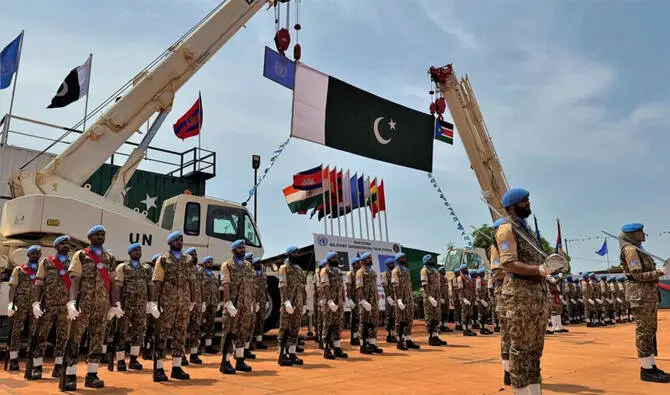
On the historic occasion of the International Day of United Nations Peacekeepers 2026, the Government of Pakistan, alongside the Inter-Services Public Relations (ISPR), has issued a joint declaration paying rich tribute to the invaluable contributions and ultimate sacrifices rendered by the global “Blue Helmets.”
As one of the world’s most enduring and significant troop-contributing countries (TCCs), Pakistan utilized the 2026 milestone to advocate for a structural and technological overhaul of modern peacekeeping architecture to meet the demands of increasingly asymmetric war zones.
PM Sharif reaffirms Pakistan’s commitment to UN peacekeeping missions, paying tribute to peacekeepers serving globally on International Day of UN Peacekeepers. pic.twitter.com/Z9WGmIG2zh
— Pakistan TV Digital (@PakistanTVcom) May 29, 2026
A Six-Decade Legacy of Global Service
Pakistan’s relationship with United Nations peacekeeping operations spans over 64 years of uninterrupted commitment, characterized by massive operational scale:
-
The Human Capital: Since 1960, more than 237,000 Pakistani personnel have deployed across 48 standalone UN missions worldwide.
-
The Ultimate Sacrifice: A solemn roll call of 183 brave Pakistani peacekeepers have laid down their lives in the line of duty under the UN flag.
-
Active Deployments: Pakistani blue helmets remain heavily engaged in some of the globe’s most volatile, high-risk operational theaters, including the Democratic Republic of Congo (MONUSCO), South Sudan (UNMISS), and the Central African Republic (MINUSCA).
Evolution of the Threat Landscape: “Invest in Peace”
The core of the state’s message aligned directly with the UN’s 2026 global theme, “Invest in Peace,” prompting a call to action from military planners regarding the shifting nature of modern warfare.
The state leadership emphasized that contemporary peacekeepers are no longer merely policing traditional borders. Instead, they are navigating fluid, hybrid conflict zones defined by cybersecurity risks, digital misinformation operations, political fracturing, and sudden climate-induced humanitarian emergencies.
CRITICAL ANALYSIS
Pakistan’s 2026 declaration marks an analytical turning point. It openly challenges the outdated, mid-20th-century template of international peacekeeping, arguing that simple troop placement is no longer an effective deterrent against modern, decentralized security threats.
The Technological Deficit in Blue Helmet Mandates
By explicitly calling for a “technological and structural evolution,” the Pakistani military establishment is addressing a critical vulnerability in current UN mandates. Peacekeepers are frequently deployed into gray-zone conflicts with strict, conventional rules of engagement, leaving them highly exposed to non-state actors who utilize weaponized drones, deepfakes, and cyber-sabotage.
Pakistan’s push for advanced intelligence architecture and data fusion tools indicates that true “investment” in peace requires giving frontline troops the predictive capability to intercept digital and physical kinetic actions before they materialize, rather than assessing the fallout after an ambush.
Climate Resilience as a Hard Security Variable
Furthermore, the integration of “climate-resilient operational frameworks” into the core peacekeeping manifesto represents a vital conceptual expansion. In theaters like South Sudan and Central Africa, resource scarcity driven by desertification and sudden floods serves as the primary catalyst for inter-communal warfare.
By instructing its forces to combat climate-driven challenges on the ground, Pakistan is recognizing that environmental degradation is not merely a humanitarian issue—it is a direct trigger for armed conflict. Consequently, future peacekeeping infrastructure must be engineered to withstand severe weather anomalies to remain logistically viable.
Soft Power and Specialized Training
Domestically, this joint declaration serves as an assertion of strategic soft power. Through institutional frameworks like the Centre for International Peace and Stability (CIPS) in Islamabad—which trains international officers—and a steadily growing deployment of Pakistani women peacekeepers, Pakistan is actively positioning its human capital as an indispensable asset to the UN Security Council.
At a time when global alliances are fracturing under regional conflicts, maintaining a highly trained, multi-dimensional peacekeeping force ensures that Pakistan retains substantial diplomatic leverage and a respected voice in the multilateral arena.
The Takeaway: Pakistan’s message for 2026 is an urgent reminder to the international community: enduring peace cannot be sustained through political inertia. Without an immediate, collective investment in technical modernization, protective civilian mechanisms, and climate-adaptive defense structures, the traditional blue helmet model risks becoming obsolete in the face of tomorrow’s hybrid battlefields.
International Day of United Nations Peacekeepers 2026, Pakistan UN Blue Helmets tribute, Invest in Peace theme 2026, Pakistani peacekeepers killed in action, ISPR UN peacekeeping statement, MONUSCO UNMISS MINUSCA deployments.