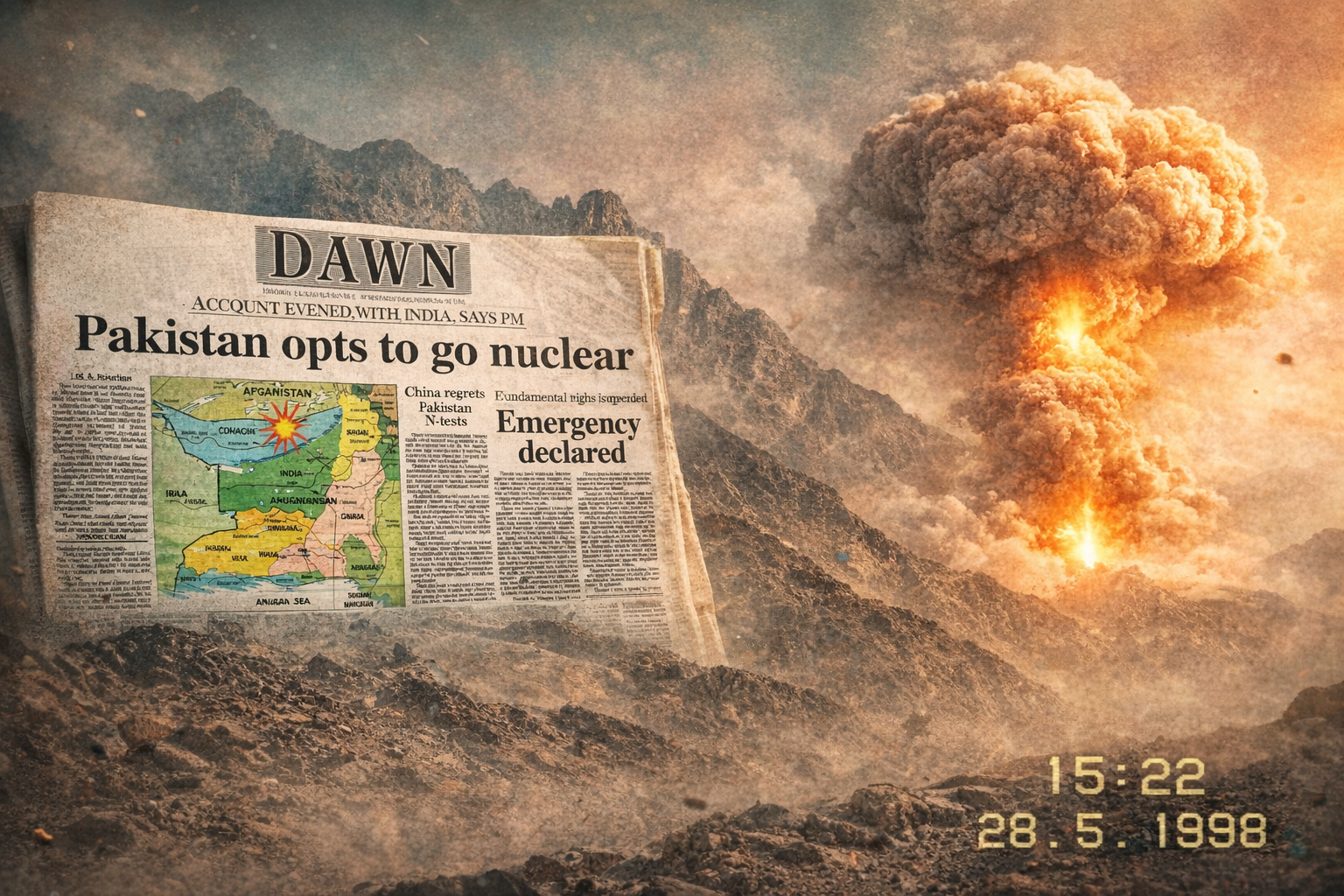
The rugged hills of Chagai, Balochistan, witnessed a series of underground tremors on May 28, 1998, that forever altered the geopolitical landscape of South Asia. By conducting five simultaneous nuclear tests (codenamed Chagai-I), followed by a sixth on May 30 (Chagai-II), Pakistan officially became the world’s seventh nuclear power and the first in the Muslim world.
These tests were not merely a scientific achievement; they were a strategic masterstroke that neutralized a decades-long conventional military imbalance and dictated a new “power of parity” in the region.
Youm-E-Takbir Mubarak 🚀 🇵🇰
On 28th May, 1998, Pakistan conducted its first successful nuclear tests, at Chagai, Balochistan marking its entry into the group of nuclear-armed states.
Till this date Pakistan is the only Muslim Nuclear Power in the world. pic.twitter.com/cJEbjUHmhR
— Pakistan Strategic Forum (@ForumStrategic) May 27, 2025
I. The Road to Chagai: Defying Global Pressure
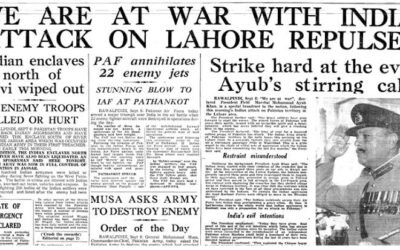
The journey toward nuclear capability was born out of a “security dilemma.” Following the traumatic events of 1971 and India’s 1974 “Smiling Buddha” nuclear test, Pakistani leadership recognized that conventional forces alone could not guarantee national survival.
The Diplomatic Siege
Pakistan’s pursuit of the “Islamic Bomb” was met with fierce international resistance. Throughout the 1980s and 90s, the country navigated a minefield of diplomatic hurdles:
- The Symington and Pressler Amendments: These U.S. laws led to the suspension of military and economic aid. The Pressler Amendment, in particular, was a “moving goalpost” that required the U.S. President to certify annually that Pakistan did not possess a nuclear device—a certification that became impossible by 1990.
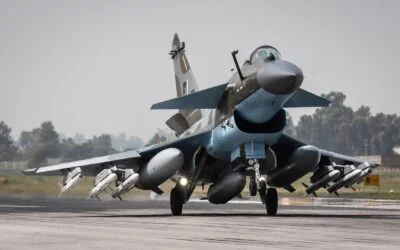
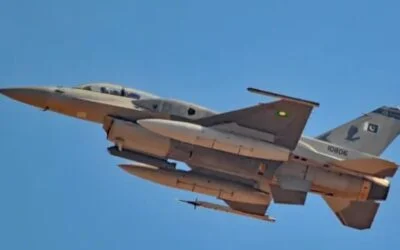
- The 1998 Ultimatum: After India’s Pokhran-II tests, world leaders—including U.S. President Bill Clinton—exerted immense pressure on Pakistan. Clinton reportedly made five phone calls to Prime Minister Nawaz Sharif, offering a $5 billion aid package and the delivery of F-16s that had been withheld for years if Pakistan refrained from testing.
- Sanctions and Sovereignty: Finance Minister Sartaj Aziz initially warned of economic collapse, as Pakistan’s foreign exchange reserves were dangerously low. However, the military and scientific community, led by figures like Dr. Abdul Qadeer Khan and Dr. Samar Mubarakmand, argued that without a matching response, Pakistan would be vulnerable to Indian nuclear blackmail. Pakistan chose “national honor over economic ease,” fulfilling Zulfikar Ali Bhutto’s famous vow to “eat grass” if necessary.
II. Dictating Regional Power Dynamics
The 1998 tests fundamentally shifted the South Asian power structure from a hegemonic model (where India dictated terms) to a deterrence-based model.
Strategic Parity and Internal Balancing
Before 1998, Pakistan relied on “external balancing”—aligning with great powers like the U.S. and China—to counter India. Nuclearization allowed for Internal Balancing. It effectively rendered India’s 2-to-1 conventional edge in tanks, aircraft, and manpower moot. In a nuclear environment, “victory” in the traditional sense becomes impossible because the cost of winning is the total destruction of the victor.
Full-Spectrum Deterrence (FSD)
Pakistan’s doctrine evolved from “Credible Minimum Deterrence” to Full-Spectrum Deterrence. This was a response to India’s Cold Start Doctrine (a plan for rapid, limited conventional strikes that would stay below a perceived nuclear threshold).
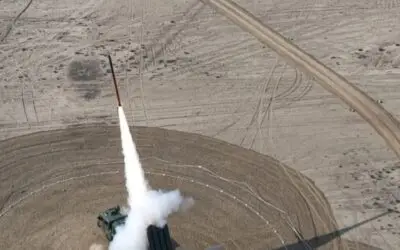
- Tactical Nuclear Weapons (TNWs): By introducing the Nasr (Hatf-IX) missile—a short-range, nuclear-capable system—Pakistan signaled that it would use low-yield weapons against invading troops on its own soil.
- Closing the Gap: This “plugged the loophole” in the deterrence ladder, ensuring that there is no space for even a limited conventional war without the risk of nuclear escalation.
III. Preventing Aggression: The Stability-Instability Paradox
Nuclear weapons have created the Stability-Instability Paradox in South Asia: while they make large-scale war (stability) nearly impossible, they may encourage lower-level skirmishes (instability). However, the “nuclear overhang” has repeatedly saved the region from total war:
- The 2001-2002 Standoff: Following an attack on the Indian Parliament, nearly a million troops were mobilized. The standoff lasted months, but India refrained from crossing the border, largely due to the uncertainty of Pakistan’s nuclear “red lines.”
- The 2019 Balakot Crisis: Even after aerial dogfights and the capture of an Indian pilot, both nations quickly de-escalated. The realization that a conventional “surgical strike” could spiral into a nuclear exchange forced both leaderships to step back from the brink.
- Redefining “Victory”: For India, the traditional goal of “slicing through” Pakistan’s heartland is no longer a viable military objective. The deterrent ensures that Pakistan’s territorial integrity is protected not by the size of its army, but by the weight of its arsenal.
IV. Shield Against External Threats and Hegemony
Beyond the immediate threat from India, nuclear arms serve as a sovereign shield against broader external pressures.
Strategic Autonomy
In an era where several nations (like Libya or Iraq) faced foreign-led regime changes after abandoning their unconventional programs, Pakistan’s nuclear status provides a “hard shell.” It prevents external powers from using military coercion to dictate Pakistan’s internal or foreign policies.
Preventing “Lebanonization”
Adversaries have often sought to exploit Pakistan’s internal ethnic and political fault lines. A nuclear-armed state, however, is much harder to destabilize from the outside because foreign intelligence agencies and militaries must calculate the risk of pushing a nuclear-armed state into a corner where its survival is threatened.
V. The Four Red Lines: Defining Pakistan’s Strategic Thresholds
While Pakistan maintains a policy of strategic ambiguity to keep its adversaries guessing, senior military officials, most notably Lt. Gen. (Retd) Khalid Kidwai, have articulated four “red lines.” These are the specific thresholds that, if crossed by an aggressor, could trigger a nuclear response. These red lines are designed to ensure that any conventional war does not escalate to a point where the state’s survival is compromised.
Spatial Threshold
This red line is crossed if a large part of Pakistan’s territory is occupied by an invading force. Given Pakistan’s lack of “strategic depth” (its narrow geographic width compared to its long border with India), even a shallow penetration by enemy tanks toward major cities like Lahore or Sialkot could be viewed as an existential threat.
Military Threshold
This refers to a scenario where a significant portion of Pakistan’s military—specifically its Air Force or Army—is destroyed or neutralized to the point that it can no longer defend the state conventionally. If the “cohesiveness of the defense” is lost, nuclear weapons serve as the final backstop to prevent a total military collapse.
Economic Threshold
Often considered the most unique of the four, this red line involves deliberate attempts to paralyze Pakistan’s economy. Examples include a total naval blockade of Karachi and Gwadar ports or the illegal stoppage of water flow from the Indus River system. Since these actions would lead to the slow “death” of the nation, Pakistan reserves the right to respond with its ultimate deterrent.
Political Threshold
This threshold is breached if an adversary engages in large-scale psychological warfare or supports internal subversion aimed at the “disintegration” of the country. Drawing lessons from 1971, Pakistan’s doctrine signals that any attempt to break away a province or spark a civil-war-like situation through foreign meddling will be treated as an act of war worthy of a strategic response.
VI. Completing the Triad: The Sea-Based Second-Strike Capability
A deterrent is only effective if it can survive an initial enemy strike. To ensure this, Pakistan has focused on developing a Second-Strike Capability through its naval leg. The successful testing of the Babur-3 Submarine-Launched Cruise Missile (SLCM) from an underwater platform has been a game-changer. By placing nuclear-capable missiles on stealthy, mobile submarines in the Arabian Sea, Pakistan ensures that even if its land-based assets are targeted, it retains the ability to retaliate, thereby making a “pre-emptive” strike by an adversary a suicidal venture.
VII. Conclusion
Pakistan’s acquisition of nuclear weapons in 1998 was the ultimate guarantor of its survival. It transitioned the country from a state of perennial vulnerability to one of strategic permanence. By maintaining a second-strike capability and a robust Command and Control system through the National Command Authority (NCA), Pakistan has ensured that the “shadow of the bomb” remains a shadow of peace—enforcing a cold, calculated restraint on all its adversaries.