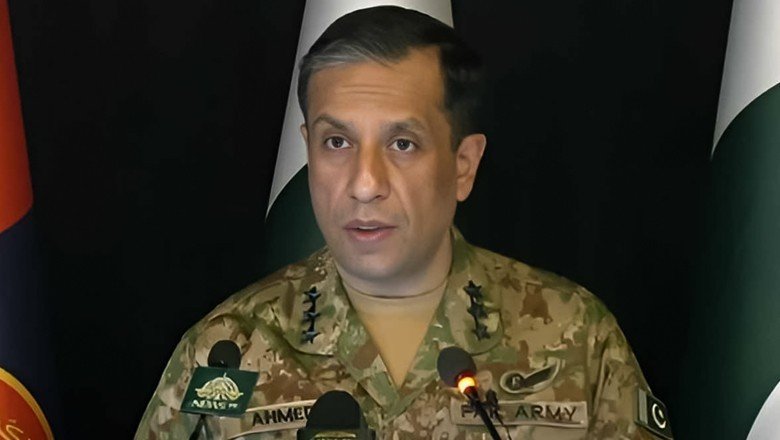
Pakistan’s security forces escalated the war on terror to unprecedented levels. In a January 2026 ISPR press briefing, DG Lt. Gen. Ahmed Sharif Chaudhry revealed that 75,175 intelligence-based operations (IBOs) had been conducted in the country in 2025. This massive campaign, involving the Army, police, Frontier Corps, and intelligence agencies, averaged 206 targeted raids per day against terrorist hideouts and networks. As DG ISPR noted, it was a “landmark and consequential year” for the fight against terrorism, marked by unprecedented intensity in counter-terrorism efforts. The Pakistan Army’s integrated counter-terrorist operations have yielded concrete success in weakening militant capabilities and strengthening national security, drawing on lessons from previous campaigns such as Zarb-e-Azb (2014) and Radd-ul-Fasaad (2017).
🚨 BREAKING: DG ISPR Lt Gen Ahmed Sharif Chaudhry briefs media on Pakistan’s security situation.
75,175 counterterrorism operations conducted last year, revealed DG ISPR.
“Terrorists are Khawarij and have no connection to Islam,” he added, asserting that the state is committed… pic.twitter.com/VsaSLRpeFb
— SAMAA TV (@SAMAATV) January 6, 2026
Historical Context: Zarb-e-Azb to Azm-e-Istehkam
Pakistan’s modern approach to counterterrorism is built on a decade of major offensives. After cleansing North Waziristan in Operation Zarb-e-Azb (2014), the military launched Operation Radd-ul-Fasaad across the country in 2017 to destroy any remaining militants. Under Radd-ul-Fasaad, law enforcement increased the use of intelligence-driven raids, expedited the handling of terror cases, curbed financing, and countered extremist propaganda. In June 2024, to consolidate these gains, the government approved Operation Azm-e-Istehkam (“reinvigorated campaign”), a drawdown of the National Action Plan (NAP). As the DG ISPR explained, all political parties have now agreed to the full implementation of the revised NAP, which entails the simultaneous implementation of both kinetic operations and socio-economic measures. This consistency of effort set the stage for the current counter-terror surge.
Scope and Results of More Than 75,000 Operations
By any measure, the scale of the 2025 campaign is historic. Nationwide, 75,175 intelligence-based raids were recorded. A breakdown shows 58,778 such operations in Balochistan and 14,658 in Khyber Pakhtunkhwa (KP), with the remainder in other provinces. These focused operations have directly weakened terrorist networks:
- Militants Neutralized: Security forces killed 2597 terrorists in 2025 (most from the TTP and BLA).
- Attacks Averted: There were a total of 5,397 terrorist attacks during the year, with 71% occurring in KP and 29% in Balochistan. The high operation count has blunted many planned attacks, as seen when 27 suicide bombers (including two female attackers) failed in 2025.
- Cost of Conflict: Despite successes, the campaign has been costly. 1235 security personnel and civilians were martyred throughout Pakistan in 2025. (For perspective, in 2021, the militants-security casualty ratio was 1:3; in 2025, the ratio was turned around to about 2 to 1 in favor of security forces.)
These figures underscore the intensity of the campaign and its effectiveness. As DG ISPR Chaudhry summarized, the Pakistan forces are now capable of defeating militancy “through force and strength, not through appeasement”. According to DG ISPR, 2025 “was the year of an unprecedented intensity of counter-terrorism efforts” and the country reached “complete clarity regarding the threat of terrorism.”
Coordinated, Intelligence-Based Operations
The counterterror campaign is marked by inter-agency cooperation and modern techniques. Operations are intelligence-based, using surveillance and tips to target high-value targets with as little collateral damage as possible. The Army has close ties with provincial police, the Frontier Corps (FC), Rangers, and several intelligence outfits. In Balochistan, for instance, the provincial government established district coordination committees, which bring together representatives of MPAs, deputy commissioners, DPOs, the army, and intelligence. Between Feb-Nov 2025, these bodies held 472 meetings, identifying 127 completed development projects and 949 planned projects, with funding of Rs 23 billion from provincial and Rs 8 billion from federal budgets. This civil-military synergy helps ensure that security gains are transformed into local development. A new National Intelligence Fusion and Threat Assessment Centre has been created to integrate data from all agencies, and the Pakistan Land Port Authority now coordinates security at the border crossings. These measures institutionalize coordination and sustain the momentum of operations.
Strategic, Social, and Economic Impact
Strategically, the campaign is reducing militants’ safe havens and increasing the cost of terror. The DG ISPR noted that major attacks, such as those on FC headquarters and public transport in 2025, were traced back to militants based in Afghanistan. The Army’s limited cross-border strikes in October 2025 further disrupted TTP command nodes without targeting Afghan civilians. Domestically, the focus on intelligence-led raids has been credited with averting general sectarian or city-wide violence. Pakistan’s security agencies now emphasize that there is no link between terrorist groups and Islam or ordinary Pakistanis. This narrative, that militancy is a foreign-fueled menace, helps the public view the Army’s campaign as the defense of national stability and not ‘our own people,’ as DG ISPR Chaudhry stressed.
Socially, the clearing of areas of militants has enabled civilians to return to normal life in previously contested areas. In Swat and Bajaur, previous operations resulted in rebuilding schools and hospitals, while the current operations provide similar levels of security to communities in KP and Balochistan. The DG ISPR has mentioned hundreds of new projects recently completed, and thousands of community engagements carried out under the revamped NAP framework. For example, the Balochistan committee projects, made possible by security, are restoring local infrastructure and improving governance. Even in KP, the Army acknowledges that countering terrorism is essential if the province’s mineral wealth and human potential are to benefit its people. In terms of economy, security, and stability are important for investment and growth on the borders. As one commentator put it, the decades-long anti-terror campaign of Pakistan has “cleaned the garbage” (militancy) out of the country, opening the way for development.
Key Messages from DG ISPR
In his January 2026 press conference, Lt. Gen. Chaudhry emphasized unity, resolve, and continued vigilance. He repeatedly called it a “national war”, and not just the burden of the Army, which required the support of the people and the unity of policy. The DG ISPR emphasized that the defeat of terrorism must rely on force and not appeasement, and it mobilized political and civic leaders around this consensus. He hailed the collective adoption of the revised NAP as well as Operation Azm-e-Istehkam as proof of one united resolve. Importantly, the DG also brought an international lens: he highlighted how Pakistan has made clear to the world that terrorism in the region was orchestrated mostly from the soil of Afghanistan. He accused some external sponsors of exploiting Afghanistan as a “hub” for militants and noted (with evidence) that groups like the TTP and BLA are now led from there. By exposing these links, Chaudhry hoped to pre-empt narratives that Pakistan stands alone to be blamed and win global support for action against terrorists. At home, the DG stressed that security forces adopt new technology and small unit tactics (including exclusive surveillance drones) to ensure the safety of civilians. In short, his messaging was that Pakistan is fighting terrorism with strength, unity, and clarity, and is determined to prevail.
DG ISPR Lieutenant General Ahmed Sharif Chaudhry, holds a detailed briefing/press conference on Counter Terrorism Operations in Pakistan during 2025#DGISPR #Pakistan #ISPR pic.twitter.com/1ish0c4y79
— Pakistan Armed Forces News 🇵🇰 (@PakistanFauj) January 6, 2026
Continuous Challenges & Outlook
Primarily, while the military and civilian leaders are celebrating the successes, they recognize that there have been persistent issuesHe lamented poor conviction rates in terrorism cases as well as incomplete camp clearances as vulnerabilities. Another hurdle is the Afghan factor: Hundreds of foreign militants are now on the Pakistani border, and the DG warned that only full international pressure on Kabul can close that safe haven. Socio-economic grievances and electoral politics also affect security in the northwest. Nevertheless, the strategy remains steadfast: intelligence-led raids, inter-agency coordination, and public resiliency. DG ISPR Chaudhry reiterated that there should be no political or regional complications to weaken operations. As he put it, “if the nation does not stand united,” the consequences will fall upon every home. This resolves with the sacrifices of the martyrs of 2025; we are supposed to carry Pakistan through these next challenges.
Conclusion
Pakistan’s counter-terrorism campaign of 2025 has been the largest domestic security initiative in modern times. Over 75,000 operations were conducted against extremist networks throughout the country. These raids, aided by a new intelligence capability and strengthened by civil-military unity, have disrupted terror plots and caused severe losses to militant groups. At the same time, accompanying development initiatives and public messaging, championed in the DG ISPR’s address, have helped reinforce the strategic goal: a stable and secure Pakistan. The leading role of the Pakistan Army in this campaign is a cornerstone of the country’s defence, and a guarantee that the sacrifices of the past year will be rewarded by long-term peace. As DG ISPR Chaudhry has affirmed, no power in the world can stop us from winning this fight, provided the country remains united behind its security forces. In this spirit, the people of Pakistan are continuing with resolve to eradicate terrorism and to secure their future.