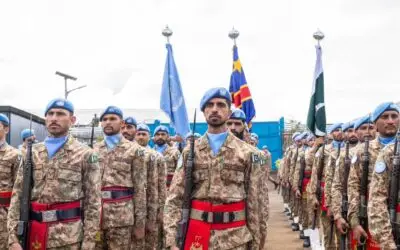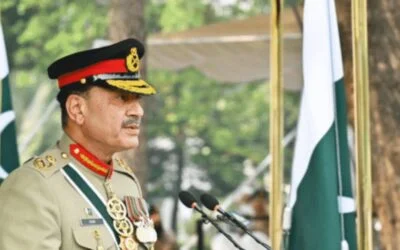
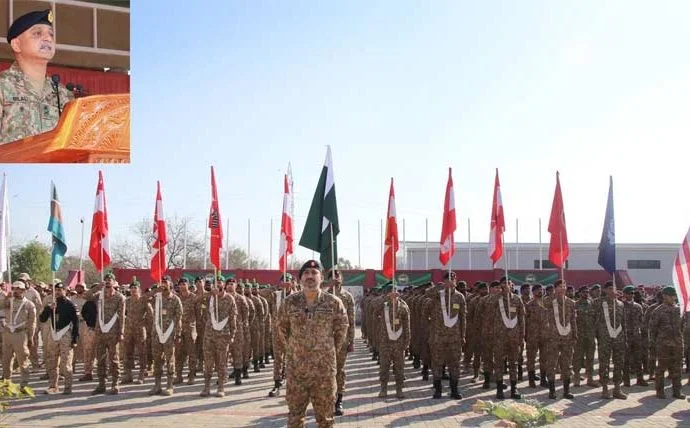
On February 4, 2026, Pakistan launched the 9th International Pakistan Army Team Spirit (PATS) Competition at the National Counter Terrorism Centre (NCTC) in Pabbi. The opening ceremony featured a parade of Pakistani and international contingents, and the proceedings formally marked the start of a grueling 60-hour patrolling exercise to test the endurance and teamwork of the Pakistani Armed Forces. In this annual event, Pakistan Army units compete with 24 teams from 19 ‘friendly’ countries, including Bahrain, Bangladesh, Saudi Arabia, Turkey, the United States, and others.
The Pakistan military describes Team Spirit as a mission-specific, task-oriented competition that challenges all contestants to meet the highest standards of physical fitness, mental strength, and tactical skill while competing in an intense, high-pressure environment. Hosting this exercise underscores Pakistani confidence and leadership in multinational military cooperation and symbolizes its commitment to peace and security in the region.
#ISPR
Rawalpindi, 04 February, 2026The opening ceremony of the 9th International #Pakistan Army Team Spirit (PATS) Competition–2026 was held at the National Counter Terrorism Centre (NCTC), Pabbi, aimed at enhancing military-to-military cooperation amongst contingents from… pic.twitter.com/2Rv8Ksr3mj
— Pakistan Armed Forces News 🇵🇰 (@PakistanFauj) February 4, 2026
Strategic Significance
By hosting Team Spirit-2026 for the 9th year, Pakistan is demonstrating its strategic role as a security hub and reliable partner. The exercise not only enhances fighting readiness but also reflects Pakistan’s resolve to take a lead in conducting complex operations. The ISPR emphasizes that Team Spirit is conducted annually on Pakistani soil and demonstrates Islamabad’s capacity to keep its training grounds and logistical support secure for large-scale exercises. The challenging 60-hour patrolling exercise, carried out in a realistic and often rugged environment, strengthens Pakistan’s combat efforts.
On a practical level, such rigorous exercises help deter threats by proving that Pakistan Army units are trained and battle-ready. Moreover, organizing such a multinational event of this scale successfully boosts Pakistan’s credibility and influence in the region. It speaks volumes about the Army’s professional infrastructure and highlights the proactive nature of Pakistan’s defense posture as it deepens ties with all participating countries.
Strengthening Defense Diplomacy
Team Spirit is an important instrument of defense diplomacy for Pakistan. By inviting so many countries, from Middle Eastern and South Asian allies to Western and Central Asian partners, Pakistan extends the network of military cooperation and goodwill. The ISPR explicitly stated that PATS aims to “enhance military-to-military cooperation amongst contingents from friendly forces”. This wide participation highlights Pakistan’s role as a convener of international security cooperation.
Joint exercises build trust, develop personal relations between officers, and create channels for dialogue outside of crises. In practice, Team Spirit is a way to reciprocate training opportunities with Pakistan’s partners and to assure partners of Pakistan’s commitment to collective security. The presence of several nations also increases Pakistan’s diplomatic leverage, as each participating military gains greater familiarity with Pakistani practices and is more inclined toward partnership.
The opening ceremony of the 9th International Pakistan Army Team Spirit (PATS) Competition–2026 was held at the National Counter Terrorism Centre (NCTC), Pabbi, aimed at enhancing military-to-military cooperation amongst contingents from friendly forces. The inaugural event,… pic.twitter.com/Xke6pODRXn
— PTV News (@PTVNewsOfficial) February 4, 2026
Participating Countries and Collaboration
An example of the exercise’s global reach is the list of participating countries. Teams from Bahrain, Bangladesh, Belarus, Egypt, Iraq, Jordan, the Kingdom of Saudi Arabia, Malaysia, Maldives, Morocco, Nepal, Qatar, Sri Lanka, Turkey, the United States, and Uzbekistan are competing in 2026, and delegations from Indonesia, Myanmar, and Thailand are observing the drills. This diversity of forces, including both Muslim-majority and secular states, reflects the breadth of Pakistani defense relations.
Many of the participating countries have longstanding military relations with Pakistan or share security interests, and their involvement in Team Spirit signals confidence. For instance, contingents from Saudi and Malaysian forces reflect Pakistan’s close ties to the Islamic world, while the presence of Turkey signifies a strategic alliance. Even participation by Western militaries (such as the US) demonstrates Pakistan’s openness toward broad cooperation. By leading an exercise that accommodates so many different armies, Pakistan projects itself as a stable and capable partner in international security affairs.
You May Like To Read: Pakistan Security Forces Neutralize 24 Foreign-Sponsored Terrorists in Khyber Pakhtunkhwa IBOs
Enhancing Multinational Interoperability
A key goal of Team Spirit is to enhance interoperability for all participants. In the field, multinational squads patrol alongside each other under simulated combat conditions. The exercise puts a premium on quick decision-making, coordination, and communication, skills that are critical in any coalition operation. Pakistani commanders stress that troops must meet “the highest standards” even in sub-tactical missions, meaning that teams execute small-unit tactics, ambushes, and reconnaissance in a nearly real operational environment.
Through these shared challenges, soldiers from different armies exchange tactics, techniques, and procedures. For Pakistan, this is extremely valuable, i.e., interacting with foreign soldiers brings new perspectives and provides validation for Pakistan’s own ways. At the same time, allied forces learn Pakistani doctrines and terrain expertise. Such experiential learning creates a common operational language and ensures that, if a need arises, Pakistani and partner units can undertake effective combined operations.
Training Components and Objectives
Team Spirit has an intense and comprehensive training regimen. The anchor event is the 60-hour high-intensity patrolling exercise in semi-mountainous terrain (simulating the kinds of environments along Pakistan’s northern and western borders). Operating continuously, teams are expected to endure physical fatigue, negotiate difficult terrain, and react to simulated enemy contacts and ambushes. Throughout the competition, troops demonstrate core soldiering attributes, marksmanship, field craft, land navigation, combat first aid, and improvised tactics under stress.
Pakistani officials emphasize that the exercise requires the utmost levels of physical fitness, mental strength, and military skill. By the end of the exercise, each unit must demonstrate its capacity for sustained operations, adaptation to changing situations, and discipline. In this way, Team Spirit is not only testing individual skill but also developing teamwork and leadership. Importantly, Pakistani organizers also learn to incorporate lessons learned into Pakistani doctrine. Host nation teams also endure the same high standards, keeping Pakistan Army units continuously improving their capabilities in partnership with the best practices that international allies have shared with them.
Regional Security Impact and Readiness
The greater impact of Team Spirit-2026 on regional security is significant. By creating a web of interoperability among Middle Eastern, South Asian, and global partners, Pakistan is playing its part in collective preparedness against transnational threats such as terrorism and insurgency. The exercise sends out a loud and clear message of solidarity: a coalition of nations stands united under Pakistani-hosted drills. This helps stabilize the region by assuring neighbors and friends that Pakistan is a capable leader as far as peacekeeping and counter terrorism efforts are concerned.
For Pakistan’s armed forces, the exercise is also a stern rehearsal: rigorous 60-hour operations lead to improved fighting abilities, flexibility, and cooperation. All this enhances Pakistan’s own military preparedness and flexibility. Finally, the partnerships built at Team Spirit translate into stronger bilateral and multilateral relationships. As returning participating armies go back home, they take a first-hand experience of working with Pakistan’s forces, making a way for future cooperation and trust. To put it in simple words, Team Spirit helps fortify Pakistan’s defensive posture and international military partnerships that make the region more secure with confidence and shared training.
Overall, the Team Spirit 2026 reinforces the leadership role of Pakistan in regional security. By hosting a demanding and multinational drill successfully, the Pakistan Army confirms its commitment to professional excellence, its capability for defense diplomacy, and its unswerving support for peace and cooperation.
You May Like To Read: Pakistan and Romania Strengthen Defense Ties During High-Level Naval Delegation Visit