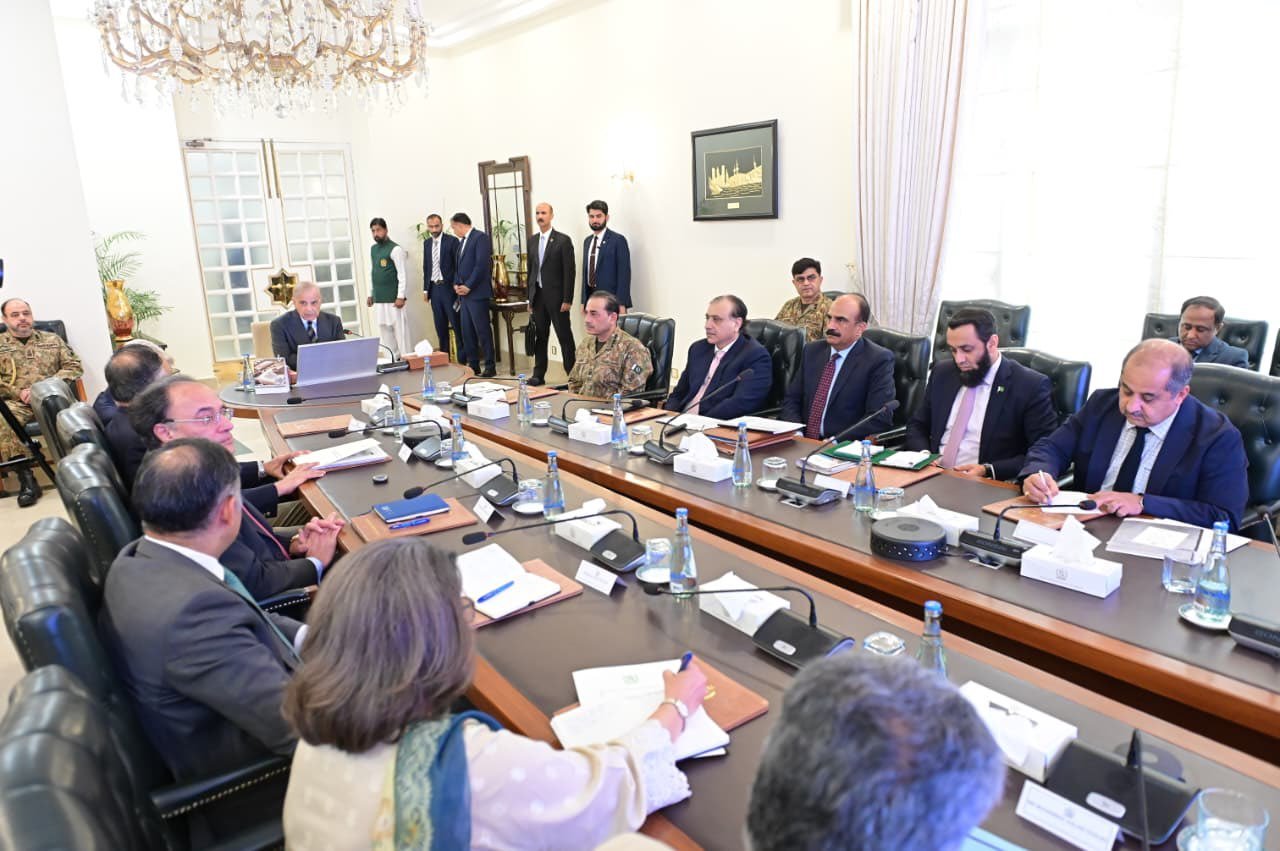
In a move that highlights the shifting view of demographic growth as a critical national security issue, Prime Minister Muhammad Shehbaz Sharif chaired a high-level review meeting focused entirely on population welfare and strategic resource management.
Reflecting a unified state approach, the session was attended by Pakistan’s top civil-military leadership, including Chief of Army Staff and Chief of Defence Forces Field Marshal Syed Asim Munir, alongside the Director-General of the Inter-Services Intelligence (ISI) and National Security Advisor Lieutenant General Muhammad Asim Malik. The high-profile presence of the national security apparatus underscores a clear reality: with Pakistan’s population growth rate climbing to an unsustainable 2.55%, demographic pressures are no longer viewed simply as a social issue, but as a direct challenge to the state’s economic stability and resource security.
Prime Minister Muhammad Shehbaz Sharif chairs a meeting on population welfare in Islamabad, #Pakistan
Field Marshal Syed Asim Munir, NI (M), HJ, #COAS & CDF, and Lieutenant General Muhammad Asim Malik, Pakistan’s National Security Advisor (NSA) and DG ISI attend the important… pic.twitter.com/vqhxtORX8y
— Pakistan Armed Forces News 🇵🇰 (@PakistanFauj) June 30, 2026
The Strategic Framework for Population Management
The high-level meeting finalized an integrated, nationwide strategy built around institutional restructuring, cross-provincial coordination, and targeted narrative management:
1. Institutional Restructuring and the National Population Council
To move past previous policy failures, the federal government is centralizing population policy under a unified executive command. Prime Minister Shehbaz Sharif will personally head the newly established National Population Council, which will serve as the premier platform for national policymaking. To ensure smooth execution across Pakistan’s decentralized political landscape, the council will include the Chief Ministers of all four provinces, the Prime Minister of Azad Jammu and Kashmir, and the Chief Minister of Gilgit-Baltistan.
Crucially, the permanent Secretariat of the National Population Council is being established directly within the Ministry of Planning, Development and Special Initiatives, legally binding demographic strategy to national economic and developmental planning.
2. The Resource-Demographic Balance
The state’s current position links unchecked population growth directly to economic friction. During the briefings, federal planners warned that a high growth rate dilutes macroeconomic gains; for instance, if the national economy grows at 3% while the population increases by 2.5%, the real progress left over for human development is effectively wiped out.
The Prime Minister emphasized that balancing resources and population growth is the primary guarantee of sustainable development. Moving forward, the state will explicitly align all future population planning with human resource optimization, energy security projections, and national food stability.
3. Integrated Awareness Campaigns and Global Models
Rather than relying on isolated health initiatives, the government is launching an expansive, nationwide public awareness campaign to promote family planning. This media and educational rollout will be integrated directly with existing state social protection networks, ensuring that social safety net benefits are strategically aligned with family planning participation.
Furthermore, the committee reviewed successful, rights-based population management models from peer nations—specifically Bangladesh, Indonesia, and Iran—to replicate their successful strategies in lowering fertility rates through local community engagement, women’s economic empowerment, and the active involvement of local leadership.
Conclusion: The Whole-of-the-Government Defense
As Pakistan navigates a complex regional landscape—marked by intense water diplomacy over the Indus Basin on its eastern flank and ongoing mediation efforts within the broader region—protecting its internal socio-economic foundation is vital. By deploying a comprehensive “whole-of-the-government” approach that unites the federal cabinet, provincial executives, and the highest tiers of the military command, Islamabad is treating the demographic crisis with the urgency of a national defense operation. The message from the PMO remains clear: long-term strategic survival and economic sovereignty depend entirely on the state’s ability to successfully stabilize its demographic curve and protect its national resources for future generations.