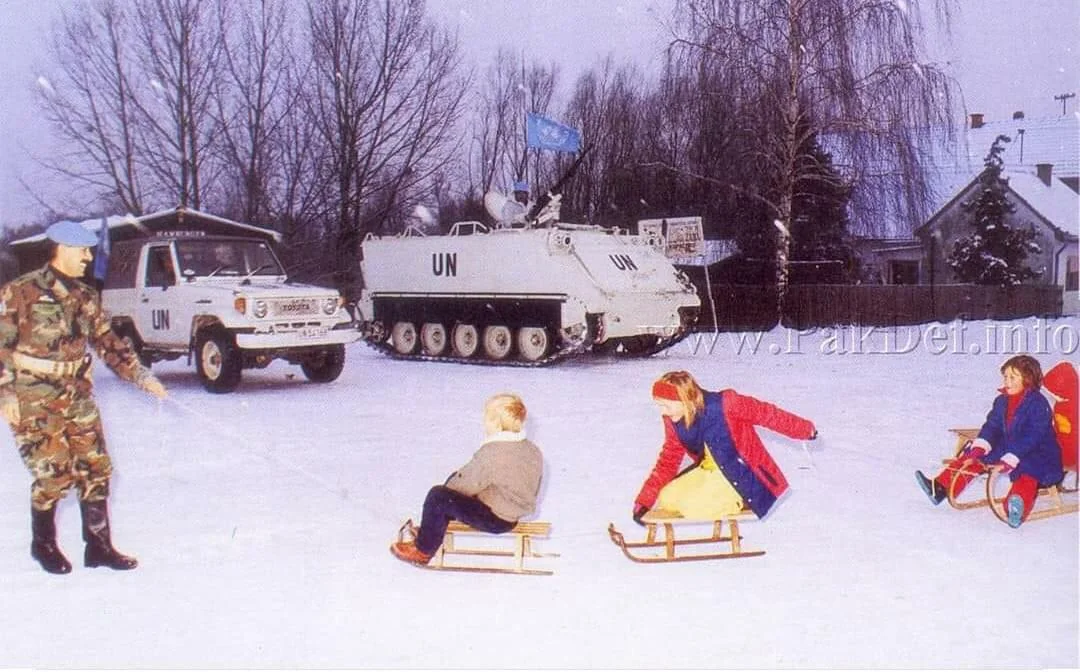
The brutal war that ravaged Bosnia and Herzegovina from 1992 to 1995 is a dark chapter in contemporary European history. As the former Yugoslavia dissolved, ethnic tensions heightened into an all-out war that was marked by mass atrocities, ethnic cleansing, and the longest war siege in recent conflict, the Sarajevo siege. As a response to this human tragedy and the world’s desperate appeals for intervention, the United Nations sent several peacekeeping missions, including the United Nations Protection Force (UNPROFOR). Pakistan, a regular provider of UN peacekeeping services around the world, responded by sending its well-trained military contingent to the midst of the conflict.
Bosnian refugee children in Pakistan’s SOS school
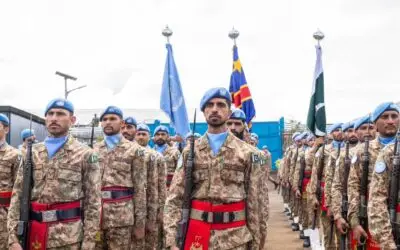
Pakistan’s participation in UNPROFOR started in 1992, and it was among the pioneer contributors to the mission in Bosnia. Initial deployments were mainly infantry battalions, support troops, and medical staff who were all assigned a vast array of difficult tasks. In contrast to customary peacekeeping, UNPROFOR operated amidst an all-out war. It was frequently trapped between opposing groups, which made its mandate very difficult and hazardous. Pakistani peacekeepers were not different. They endangered themselves every day while endeavouring to fulfill their duties.

Source: reddit
Alt text: Pak Army Engineer Corps removing land mines
One of the main functions of Pakistani contingents was the protection of civilians and the safe delivery of humanitarian supplies. The war in Bosnia generated a huge internal displacement crisis as well as a critical lack of food, medicine, and other necessities. Pakistani troops played a crucial role in transporting humanitarian convoys across perilous front lines, under constant sniper fire and artillery shelling. These troops often fasted to donate their food ration packets to Bosnian civilians. The Pakistani contingent displayed tremendous courage and a sensitive balance between firmness and impartiality to bargain access with all warring factions. Their presence offered a lifeline to beleaguered citizens, especially in remote enclaves and cities.
In addition, Pakistani soldiers helped enforce no-fly zones and the monitoring of heavy weapons exclusion zones, notably around Sarajevo. They set up checkpoints, went on patrols, and monitored adherence to UN resolutions for lessening the intensity of conflict by shielding civilian zones. This regularly put them in the face of heavily armed groups, requiring unparalleled discipline and strict observance of the rules of engagement. Their careful reporting and presence constituted a deterrent and source of independent confirmation for the international community. The Pakistani military also contributed considerably to establishing open lines of communication and paving the way for dialogue between the two opposing groups. In a conflict fueled by long-standing hatreds, the impartial presence of UN peacekeepers was essential in opening up negotiating spaces and de-escalating tensions. Pakistani commanders gained some measure of trust from all parties and were thus able to mediate ceasefires at the local level as well as settle disputes that might otherwise have escalated into broader conflicts.
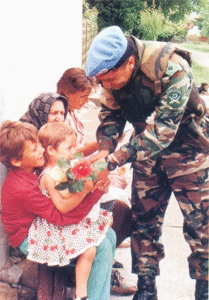
Pak UN Peacekeepers winning the hearts of the Bosnian population.
Source: reddit
Aside from the immediate operational and tactical functions, Pakistani peacekeepers played a significant role in the restoration of normalcy where feasible. This involved medical relief, infrastructure rehabilitation, and assistance with the reconstruction process. Pakistani medical officers established clinics, providing much-needed health care to civilians traumatized by war, regardless of their religious or ethnic affiliation. This assistance was proof of Pakistan’s dedication not only to peace but to the welfare of the people affected.
Pakistan’s deployment of troops to UNPROFOR in Bosnia was a demonstration of its wider commitment to international peace and security. This is a commitment to which it has answered by deploying more than 200,000 soldiers on 46 UN missions worldwide. Though the Bosnian War was finally brought to a close through a mix of diplomatic negotiation and NATO bombing, the stabilization work of UNPROFOR, and the key role Pakistani peacekeepers played, sowed the seeds for what eventually became a stable region and offered vital protection and assistance to millions trapped in the conflict. Their service and sacrifice of life are an essential, though occasionally forgotten, part of this terrible war’s history.
Pakistan’s role in the conflict was not only strictly diplomatic but also deeply personal. For its covert assistance for the Bosnian Army, specifically the role of Inter-Services Intelligence (ISI), it had to face an inquiry by the International Criminal Tribunal. Pakistan’s covert program to airlift weapons, including anti-tank missiles, to Bosnian Muslims, despite a UN arms embargo, put them in some hot water. The then DG ISI Javed Nasir later confessed to this operation. The controversy later resurfaced when the International Criminal Tribunal for the former Yugoslavia (ICTY) requested custody of Nasir for his alleged role. Pakistan refused this request by citing its poor health. This program has been referred to briefly in the Pakistani drama Alpha Bravo Charlie in 1998. Since then, foreign relations have improved between Pakistan and Bosnia.
The then Pakistani President Sardar Farooq Ahmed Khan Leghari announced that Pakistan would arm the Bosnian government irrespective of the embargo:
“The Western policy of appeasement of the Serbian aggressors is not going to pay.” [source]
The Pakistani contingent faced daunting challenges throughout this conflict. The rough terrain, brutal winters, and unstable nature of the war put their endurance and training to the test. They worked without a strong peace to maintain, operating in a landmine-saturated region with risks at every turn. Yet, amidst all the risks, Pakistani troops showcased remarkable professionalism, bravery, and commitment to duty. Their efforts were respected by the locals and praised by the United Nations.
Check out our latest video: