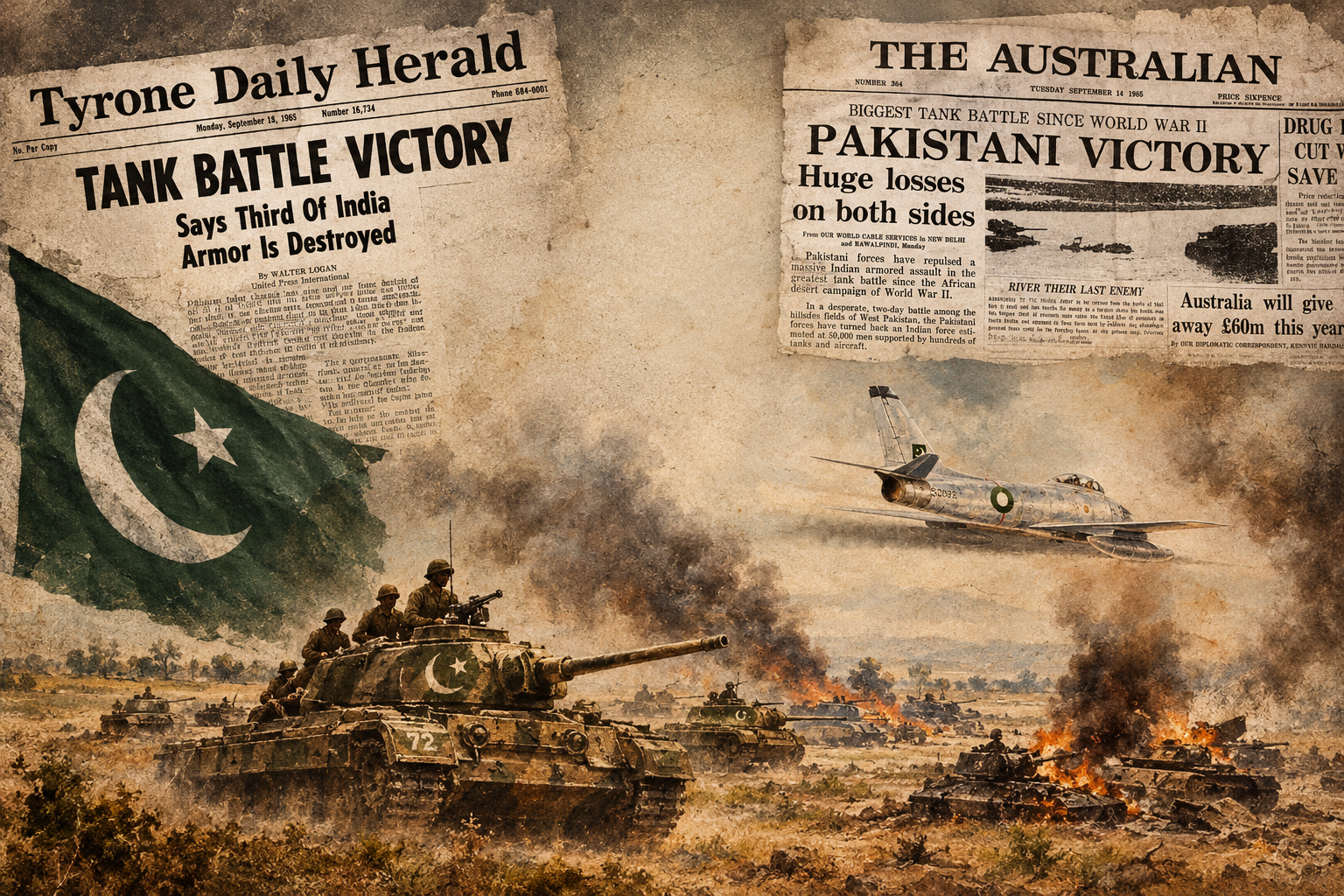
For a professional soldier, airman or sailor, wars are rarely remembered as single events. They are remembered as a sequence of decisions made under pressure, of positions held or lost, of the narrow margins that separate a successful defence from a rout. The 1965 War against India offers exactly this kind of study — a compact, seventeen-day conflict in which Pakistan’s armed forces, often outnumbered and always outgunned in raw numbers, produced a series of engagements that remain worth studying on their own military merits, not merely as patriotic memory.
The Opening Gambit: Rann of Kutch
Though the full war began in September, the contest of wills had opened months earlier in the salt marshes of the Rann of Kutch. The April 1965 clashes there were limited in scale, but they gave Pakistani commanders an early, useful reading of Indian tactical posture and reaction times — intelligence that would matter once the front widened dramatically in September. For a force that would soon be fighting on multiple axes simultaneously, this earlier engagement served as a rehearsal that sharpened both confidence and technique.
The Defence of Lahore
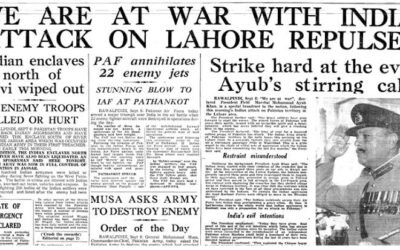
No battle of 1965 carries greater symbolic or strategic weight than the defence of Lahore. When Indian forces crossed the border on 6 September with the objective of reaching the city before Pakistan could mount an organised response, they were met by a defence built on improvisation as much as doctrine. Positions along the BRB Canal became the line that Indian armour could not cross in the opening days of the offensive, and the fighting around Barki and the canal approaches turned into some of the most intense infantry engagements of the war. That the country’s second-largest city, expected by Indian planners to fall within days, remained firmly in Pakistani hands throughout the conflict stands as the single clearest strategic outcome of September 1965.
Chawinda: The Armoured Battle
If Lahore was the war’s most symbolic front, the Sialkot sector produced its most consequential armoured engagement. The Battle of Chawinda, fought through much of September, saw Pakistani armour and infantry hold a numerically superior Indian armoured thrust aimed at cutting the Sialkot–Pasrur road and threatening Pakistan’s communications in the north. Pakistani tank crews, often fighting outnumbered, used terrain, coordinated anti-tank positions and disciplined counter-attacks to blunt successive Indian assaults. By the time the fighting in this sector wound down, Chawinda had held. For students of armoured warfare, the battle remains a frequently cited case study in how a numerically inferior force can neutralise a larger mechanised push through terrain awareness and unit cohesion rather than sheer weight of armour.
Command of the Air
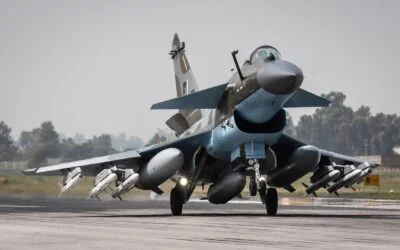
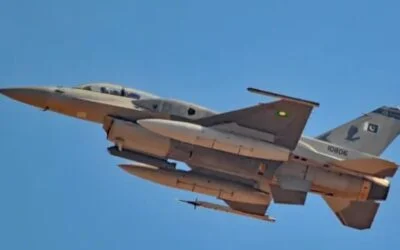
Where the 1965 War is most often remembered without qualification is in the sky. The Pakistan Air Force, flying a smaller fleet than its adversary, established an operational tempo in the war’s opening days that repeatedly disrupted Indian planning. Squadron Leader M M Alam’s feat of downing multiple aircraft in a single engagement over Sargodha became the most celebrated individual moment of the war, but the broader story was one of sustained sortie rates, effective close air support for ground troops at Chawinda and Lahore, and strikes against Indian airfields that reduced the tempo of the Indian Air Force through the critical early phase of the conflict. For an air force a fraction the size of its opponent’s, achieving even temporary superiority over key sectors of the front was a considerable operational accomplishment.
The Navy’s Reach: Dwarka
The war’s naval dimension is often given less attention than the land and air campaigns, but it produced one of the more audacious operations of the conflict. On the night of 7 September, a Pakistan Navy flotilla shelled Indian coastal installations at Dwarka, well south of the main theatre of operations. The raid caused limited material damage, but its real value was psychological and doctrinal: it demonstrated that the Pakistan Navy could project force beyond its home waters and forced Indian planners to divert attention and resources toward coastal defence at a moment when every asset was needed elsewhere.
Reading the War as Professionals
None of this is to suggest that 1965 was without cost, or that every engagement went Pakistan’s way. Wars are rarely so tidy, and no serious student of military history treats any conflict as a uniform run of victories. What the record does support is that, engagement by engagement, Pakistan’s armed forces met a larger adversary with a combination of tactical discipline, terrain use and sheer resolve that produced outcomes disproportionate to the numbers on either side. For those who serve today, the value of studying 1965 lies less in the celebration of any single battle than in the underlying pattern each of them reveals: a smaller force, well-positioned and clear in its purpose, can impose costs and delays on a numerically superior opponent that no order of battle alone can predict. That is the lesson Chawinda, Lahore, Sargodha and Dwarka each teach in their own way, and it remains as relevant to the professional soldier, airman or sailor today as it was to the one who held the line in September 1965.