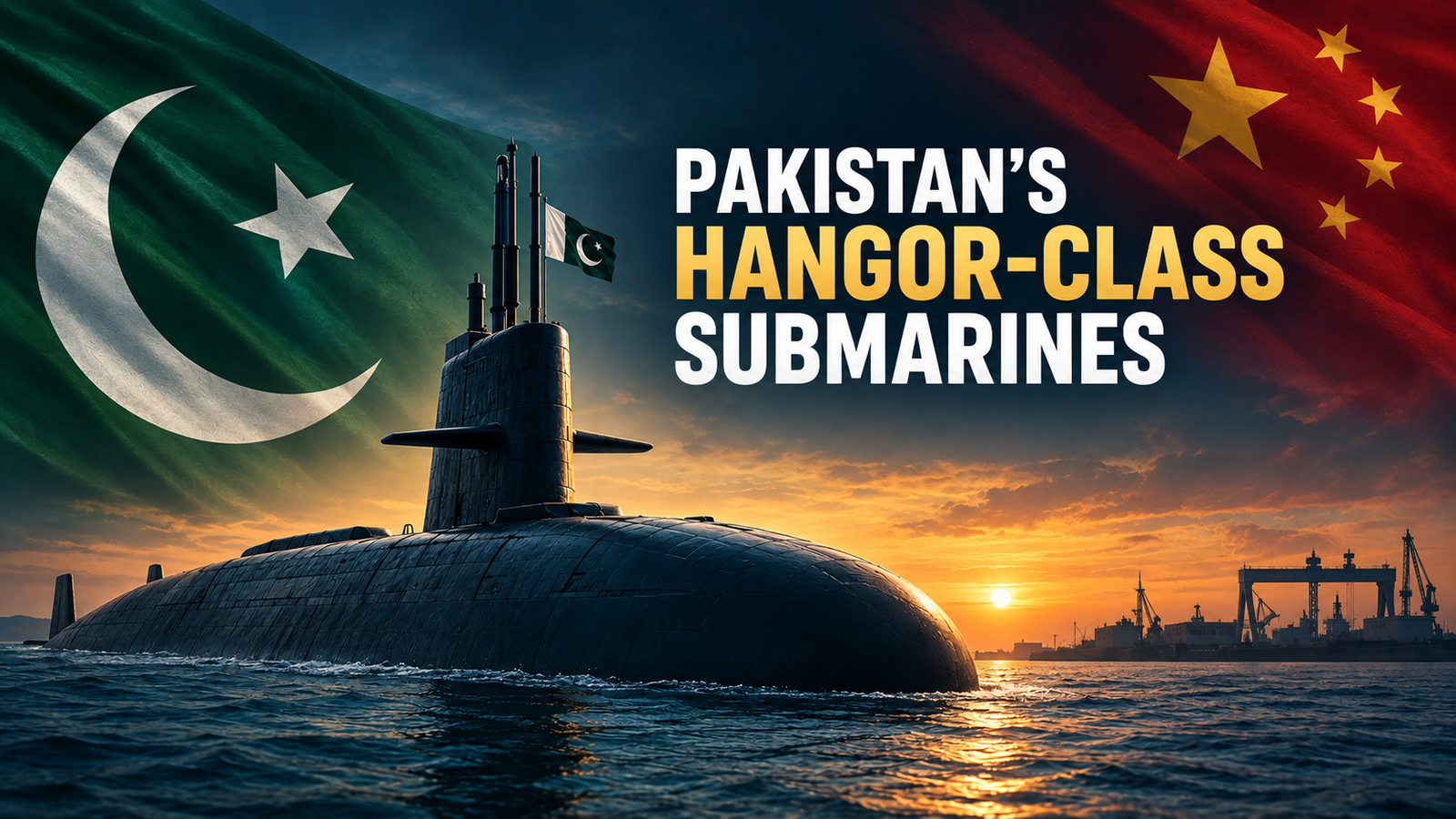
Pakistan has been making major changes to its Navy since 1964. Over the next decade, Pakistan will add eight Hangor-class submarines to its naval fleet. Of those eight, four will be built in China, while the rest will be manufactured in Karachi. No other country has purchased more submarines than Islamabad in a single deal.
The first new lead PNS Hangor was commissioned on April 30, 2026, at Sanya in the South China Sea. It ultimately arrived in Karachi on June 11, 2026. This milestone deal marks a major leap forward for the Pakistan Navy. This deal not only increases the strength and firepower of the Pakistan Navy; it also marks a major step forward in Pakistan and China’s defense ties.
Brief History of Pakistan’s Submarine Force
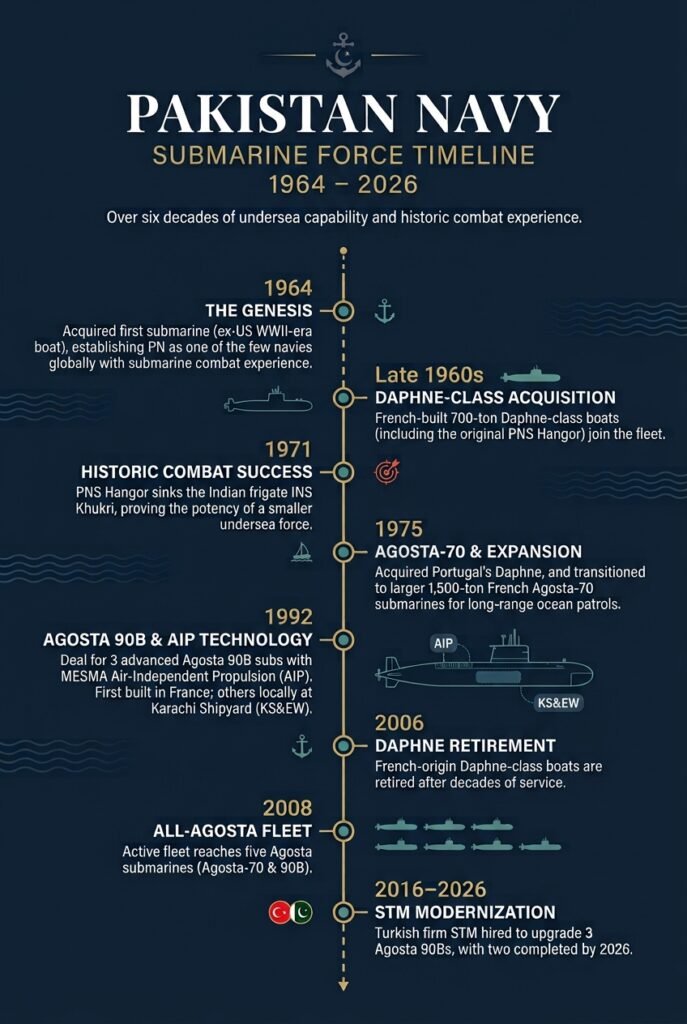
The Pakistan Navy started operating Submarines in 1964, and it is one of only three navies globally with submarine combat experience since 1945. Pakistan Navy’s first submarine, called PNS-Ghazi, was an old American submarine from World War II.
Islamabad later acquired French Daphne-class submarines. They were modern but smaller, with a capacity of only 700 tons; this was the original PNS Hangor. This submarine made history during the 1971 war against India. PNS Hangor sank the Indian Frigate INS Khukri on December 09, 1971. This attack showed how a small submarine force could inflict heavy losses on a larger navy, block ports, and threaten shipping.
In 1975, Pakistan acquired the fourth Daphne from Portugal and then shifted to French Agosta-70 submarines; they had a capacity of 1500 tons and were twice the size of Daphne boats. It was the first time the Pakistan Navy could send submarines for long ocean patrols.
Later in 1992, the Pakistan Navy negotiated with France for three more advanced Agosta 90B Submarines; these submarines used French MESMA air-independent propulsion, also called AIP. AIP lets the submarines stay submerged longer, but at a slower speed, without needing to surface. This makes them much harder for adversaries to find.
The Agosta 90B deal was quite significant for Pakistan, since only the first submarine was built in France; the rest were built at Karachi Shipyard and Engineering Works, also known as KS&EW.
The French-origin Daphne boats were retired in 2006, and by 2008 the Pakistan Navy had five Agosta submarines. In 2016, a Turkish firm, STM, was hired to upgrade the three Agosta 90B; two of those three were finished by 2026.
Brief History of Pakistan’s Submarine Force
Why Pakistan Turned to China?
In the year 2011, Pakistan tried to buy German Type 214 Submarines; however, the deal collapsed. Islamabad therefore opened talks with the Chinese firm China Shipbuilding Industry Corporation (CSIC), now called CSSC. Pakistan signed a contract for eight submarines in 2015, equipped with AIP technology. Pakistan has been buying Chinese submarines and other ships since the mid-2000s.
Between 2006 and 2013, Pakistan acquired four Zulfiqar-class frigates, an export version of the Chinese Type 05, of which three were built in China and the fourth in KS&EW. Thereafter, Azmat-class fast attack craft: three out of four were built locally. This acquisition was followed by four Tughril-class frigates, between 2017 and 2022, based on the modern Type 054A. Islamabad has also acquired a missile-range instrumentation ship from Beijing.
What is the Hangor-Class Submarine?
The Hangor-class is the export version of the Chinese Type 039B Submarine, better known in the West as the Yuan-class. Wuchang Shipbuilding in Wuhan manufactures it and has built China’s conventional submarines for decades.
The Type 039B displaces almost 2,600 tons on the surface. China has marketed the same model for export under different names, such as S20, S26, “2600 Ton Submarine,” and, more recently, the Kylin class. However, it is not confirmed whether these submarines use AIP technology; it may be the Stirling type, which has been used on Chinese Type 039B and 039C boats.
What It Adds to Pakistan’s Defenses
All four Hangor-class submarines, built by China, are expected to be in service by 2028, by the time the Pakistan Navy might retire its Agosta-70 Submarines. Meanwhile, the four submarines being built at Karachi Shipyard and Engineering Works will join service in the 2030s. Islamabad will have at least seven modern diesel-electric submarines by the end of this decade, all equipped with AIP, capable of operating far from home shores.
Acquiring and commissioning these submarines will significantly improve Pakistan’s deterrence. Pakistan Navy’s submarine doctrine is built around ambush and blockade strategy. Thus, acquiring stronger, capable, and modern boats will enable the Pakistan Navy to threaten Indian warships, ports, and even merchant traffic, if and when needed. PNS will also be capable of launching land-attack cruise missiles from a distance.
Strategic ambiguity is the second advantage. Acquiring submarines also benefits PNS. They will force enemies to assume the submarines are patrolling the waters, regardless of their actual presence. This forces enemies to plan around these submarines and never ignore them. In the Navy’s jargon, this is called “Fleet in being“; now India will have to account for seven modern boats, not five old ones.
The Trade-Off
Pakistan Navy is predominantly dependent on Chinese technology; everything on the modern warships is Chinese. Even the Hangor-class submarines’ diesel engines are Chinese. The full configuration of the submarines or boats has not been published, but the weapons, sensors, and communication gear are likely also Chinese.
Defense cooperation agreements often include the term “transfer of technology”; however, this promises more than it delivers. Building a submarine locally does not entail maintaining it independently. Pakistan would still have to rely on Beijing, or the original manufacturer, for deep maintenance and mid-life upgrades.
Moreover, fitting your own equipment on submarines or warships would require supplier approval. Even close partners work this way; Italy and Germany, for instance, still exchange component packages on their Type 212 submarines.
Hence, indigenous or local construction is real; however, complete industrial independence remains limited and distant. As Pakistan sources its entire naval ecosystem from China, dependence on Beijing grows with every hull.
Conclusion
While shifting naval suppliers like France to Turkey proved manageable for Pakistan, cutting ties with China is an entirely different story. Today, Beijing powers virtually every layer of the Pakistan Navy, bound by shared strategic interests regarding India. Unwinding a partnership deeply integrated into core defense systems would severely cripple submarine and overall fleet readiness.
Furthermore, Gulf allies must now consider whether Pakistan’s maritime support during a crisis subtly hinges on Beijing’s approval. Ultimately, major defense deals reflect strategic alignment—and over time, deep operational reliance quietly pulls national foreign policy right along with it.
Frequently Asked Questions (FAQs)
1. When was the first Hangor-class Submarine Commissioned in Pakistan Navy?
The first PNS Hangor was commissioned on April 30, 2026, at Sanya in the South China Sea. It ultimately arrived in Karachi on June 11, 2026.
2. Which Pakistan Navy submarine sank the Indian INS Khukri?
Islamabad acquired French Daphne-class boats; this was the original PNS Hangor. This submarine made history in the 1971 war against India. PNS Hangor sank the Indian Frigate INS Khukri.
3. What is the Hangor-class submarine?
Hangor-class is the export version of the Chinese Type 039B Submarine, also called the Yuan-class. The Type 039B displaces almost 2,600 tons on the surface. China has marketed the same model for export under different names, such as S20, S26, and “2600 Ton Submarine.”