India has also been actively strengthening its military ties with several countries through a spree of exercises and procurement deals in late 2025 and early 2026. For example, India, France, and the UAE carried out a massive trilateral Desert Knight air exercise over the Arabian Sea in December 2025, involving IAF Sukhoi-30MKIs, Jaguars, and tanker aircraft alongside French Rafales and UAE Mirages.
Indian Air Force (IAF) conducted Exercise Desert Knight along with the French Air and Space Force (FASF) and United Arab Emirates (UAE) Air Force. While the French participation included the Rafale fighter aircraft and a Multi Role Tanker Transport, the UAE Air Force fielded the… pic.twitter.com/rvX58Jfq3S
— ANI (@ANI) January 24, 2024
India also participated in Exercise Malabar 2025 with the US, Japan, and Australia in the Pacific, a major Indo-Pacific maritime drill described as for the purpose of enhancing the interoperability between regional partners. These exercises, and others (e.g., the ongoing India-Japan Dharma Guardian exercise), are routinely cited as enhancing India’s combat readiness and alliance cohesion in the Indo-Pacific. India’s participation in the Malabar naval drill (Guam, Nov 2025) helped increase Indo-Pacific interoperability.
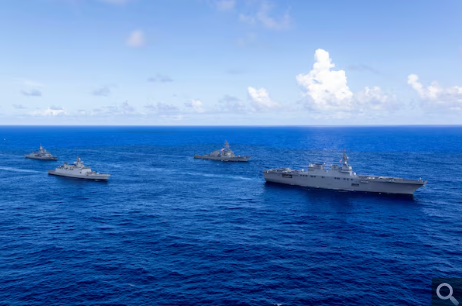
India (blue hull) worked alongside Japanese and US ships in Exercise Malabar 2025.
Source: America’s Navy
On the Indo-US front, India continued its longstanding bilateral drills. In September 2025, an Indian army contingent participated in Exercise Yudh Abhyas in Alaska alongside US forces to exercise mountain and high-altitude warfare. Earlier in April 2025, there was Tiger Triumph, a massive amphibious landing drill by the US and Indian armies in Andhra Pradesh to enhance India-US disaster response and joint action capabilities.
Apart from drills, India is securing defense ties through procurement and co-production. The Indian government cleared in January 2026 a proposal for an additional 114 Rafale fighters (18 delivered fly-away, while the bulk of them to be built in India) to strengthen the strength of the squadrons. Crucially, the majority of follow-on Rafales will be made under “Make in India” guidelines, with up to 60-80% indigenized content. India and France also agreed on a 50:50 joint venture between HAL/BEL and Safran for the HAMMER precision air-to-ground missile to provide IAF Rafales with a largely domestic rocket munition. These India-France deals, both platform buys and joint production, significantly enhance India’s airpower and signal a closer Indo-French strategic association. India’s recent acquisitions (more Rafales, missiles, drones, etc.) and drills with allies are changing its two-front posture, despite Delhi’s emphasis on “strategic autonomy” in global supply chains.
🚨Indian Air Force proposal to buy 114 Rafales cleared by defence procurement board. pic.twitter.com/W96q2snPRE
— Indian Infra Report (@Indianinfoguide) January 17, 2026
Pakistan’s Defense Diplomacy and Industry
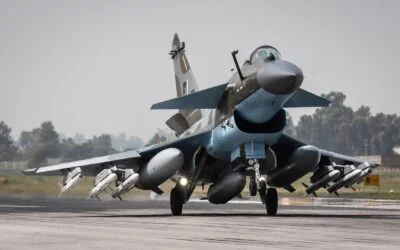
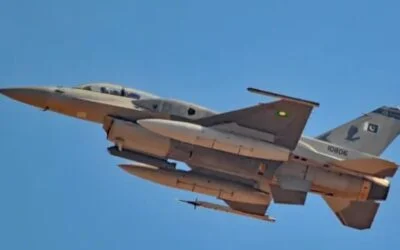
By contrast, in reaction, Pakistan is rapidly enhancing its defense exports and partnerships. A report last January highlights a $13 billion pipeline of Pakistani defense export deals, including fighter jets, trainers, armored vehicles, drones, and naval vessels. This represents a dramatic jump from historically low exports (only $22 million in 2024) and is attributed to Pakistan’s proven capabilities (e.g., in the air conflict with India in May 2025) and new state-to-state agreements. For example, Pakistan’s military recently announced a deal to provide JF-17 Thunder Block III fighter aircraft to Azerbaijan, thereby enhancing air capability and a brotherly bilateral relationship. Private reports also mention a negotiated $4 billion sale of weapons to Libya’s eastern forces (including JF-17s and trainers). Pakistan has hosted high-level delegations (e.g., of Indonesia and Bangladesh in December 2025) to discuss co-production or sales of JF-17s and Super Mushshak trainers. Islamabad’s outreach extends to the Middle East, Africa, and South Asia.
Saudi-Pakistani defense ties have increased significantly as well. Last year, Pakistan and Saudi Arabia signed a Strategic Mutual Defense Pact, and by early 2026, Pakistani officials stated that they had converted $2 billion of Saudi loans into a JF-17 sale. Meanwhile, Islamabad also engaged in defense talks with Turkey, going so far as drafting a trilateral Saudi-Pak-Turkey security pact, contending that it was attempting to present a united front in the face of regional tensions. These initiatives reflect Pakistan’s desire to be a full-spectrum security partner. Domestically, the military-run Pakistan Aeronautical Complex (PAC), Heavy Industries Taxila, POF Wah, and Karachi Shipyard are busy developing and promoting their indigenous systems, ranging from JF-17s to Al-Khalid tanks, drones to artillery, and naval platforms. The key to future growth will be the need to scale up tech (drones, missiles, avionics) and draw private firms as well as universities into Pakistan’s defense ecosystem.
#BREAKING Pakistan, Saudi Arabia in talks to convert nearly $2B Saudi loans into a JF-17 fighter jet deal.
— Reuters pic.twitter.com/WVkWjv7ZdT
— Mansoor Ahmed Qureshi (@MansurQr) January 7, 2026
🚨 🇹🇷🇸🇦🇵🇰 BREAKING: Turkey is reportedly seeking to join the Saudi Pakistan Defence Pact, a mutual defense arrangement in which an attack on one member would be treated as an attack on all, according to Bloomberg.
If finalized, the move would mark a major strategic shift,… pic.twitter.com/2WrzlW7a3J
— Defence Index (@Defence_Index) January 9, 2026
Thus, Pakistan’s industry has refocused itself on exports and self-reliance. The performance of the JF-17 has “bolstered its prestige” in discussions with potential buyers, with Pakistan seeking diversified markets (Africa and Asia) at a time when arms diplomacy by India is thriving. This dual dynamic is changing the regional balance as India’s ‘Look East’ drills and the French deals are countered by the Pakistani push southwards (Libya, Sudan) and new alliances. Both countries now view defense exports as a tool of statecraft.
Strategic Balance and Opportunities
From the perspective of Pakistani national security, the picture is nuanced. India’s growing procurements (e.g., hundreds more Rafales, French missiles) and global exercises boost its traditional advantages. Yet Islamabad sees opportunities; India’s tilt towards the US technology camp and Western Trilateral Gulf creates room for Pakistan to play a leading role in parts of the Muslim and global South. Pakistan’s own recent military successes have brought it diplomatic leverage to make high-value deals and create trilateral security frameworks (such as with Saudi Arabia and Turkey).
Unlike India, Pakistan must strengthen its balance sheet too. Most Pakistani arms deals are government-to-government or on loan, and to upgrade depleted reserves. Pakistan’s newfound position as an arms exporter can help foster a virtuous cycle that supports the development of civilian tech spillover, increased private-sector roles, and even stable long-term ties with client states. The present lull in foreign exchange makes the timely execution of defense exports crucial to national resilience. Islamabad’s challenge is to keep the momentum going by delivering on promised systems, maintaining technical quality, and employing defense diplomacy as a gateway for wider economic partnerships.
Recommendations for Pakistan’s Defense Industry
- Deepen China cooperation and tech transfer: Give priority to joint production and technology transfer with China, in order to strengthen indigenous capability and reduce dependence.
- Anchor defense deals in wider economic connections: Link arms sales with trade, investment, and infrastructure partnerships to serve as a basis for building long-term strategic relations.
- Strengthen indigenous R&D and private sector: Public-private partnerships need to be increased, and local companies need to be integrated into defense production and innovation.
- Invest export revenues wisely: Use funds earned from defense investments to modernize military capabilities using rational and long-term investment structures.
- Focus on niche, cost-effective technologies: Focus on UAVs, precision weapons, and electronic systems that provide a high impact at competitive cost.
- Maintain diversified diplomatic outreach: To maintain strategic autonomy, expand defense ties, and balance relations among the major powers.
By following these steps, Pakistan can slowly build up in military readiness, build up its industrial base, and bring up a credible weight to India’s burgeoning arms network. In Pakistan’s view, therefore, the race is not only to get more kit, but to construct a sustainable ecosystem of defense, and seize strategic partnerships that can help it secure its interests in the long run.