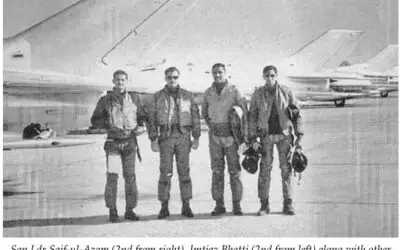

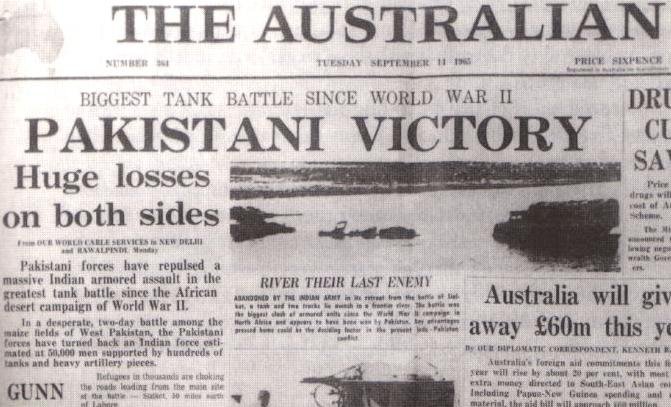
The Battle of Chawinda was fought during the 1965 Indo-Pakistani War. It is considered one of the biggest tank battles since World War II. The battle at Chawinda marked a turning point in the Sialkot sector, where the Pakistan Army defended its territory against a numerically superior Indian army. This was a decisive battle due to the determination of the Pakistani defense and the key role of the 6th Armoured Division and the 15th Infantry Division. Both formations worked in combination to check the Indian offensive and switched the course of the war in this geo-strategically important sector.
The Indian Offensive and Initial Pakistani Response
On 6 September 1965, the Indian Army mounted a massive offensive against the Pakistan Army’s I Corps. Their objective was to take the strategic Grand Trunk Road and capture the Sialkot-Pasrur railway line. Its strongest striking force was the Indian 1st Armoured Division which was backed by two infantry divisions. The objective was to sever Pakistani supply lines and surround Sialkot. The Pakistani command had foreseen a possible offensive in the region and deployed the 6th Armoured Division as a reserve around Daska. The division was tasked to remain alert to undertake any offensive at a moment’s notice.
The opening clashes, concurrent with the Battle of Phillora, saw the Indian Army making significant advances. The Indian thrust was aimed in a straight line for Chawinda, which was a vital defensive installation. The position was critical for Pakistan as the Indians far outnumbered them. It was a single Pakistani armored brigade, the 25th Cavalry, that halted the Indian thrust at Gadgor, which offered crucial time for the Pakistani high command to prepare a solid defense.
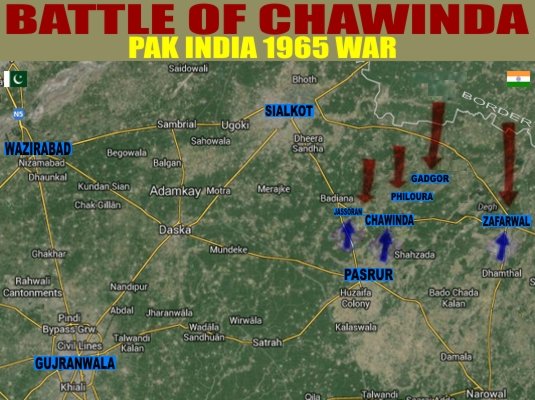
Source: pakistanarmy.biz
The Turning Point: Role of the 6th Armoured Division
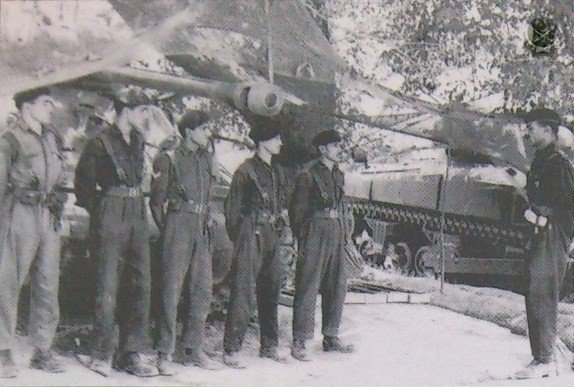
The 6th Armoured Division was led by Maj. Gen. Abrar Hussain. It was newly raised, and Chawinda would be its first big battle. Despite being a new division, it was assigned the task of confronting the seasoned and well-equipped Indian 1st Armoured Division. The deployment of the division was a master stroke in a counteroffensive to the Indian advances. Although the Indian 1st Armoured Division was the largest and strongest armored unit in the Indian Army, the Pakistani 6th Armoured Division and its parent units, particularly the 25th Cavalry, displayed unparalleled courage and tactical genius. The 6th Armoured Division’s goal was to serve as the main armored buffer for the Pakistani defense.
Its M48 Patton tanks, while not a good match for the Indian Centurions, were employed decisively along the defensive lines. The units of the division, especially the 10th and 22nd Cavalry, fought the Indian armor in intense, close-range combat. The action was fierce, with both sides taking severe losses. The Pakistani armored units, however, managed to hold firm. They were instrumental in driving back repeated attacks and caused extensive losses to the advancing Indian tank columns. The success of the division was not only in its defensive strategy but also in its counterattacks that broke the Indian offensive rhythm. Pakistani armour, with artillery support, made bold attacks all across the Indian advance flanks on many occasions. This compelled the Indian side to re-evaluate its positions and re-group. This persistent pressure prevented the Indian forces from exploiting their superiority in numbers and making a clean breakthrough the way they had expected.
Source: pakistanarmy.biz
The Indomitable Spirit of the 15th Infantry Division
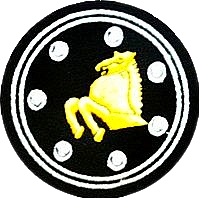
Where the 6th Armoured Division was the Pakistani defense’s armored fist, the 15th Infantry Division, which was led by Brigadier S. M. Ismai,l was its indomitable bedrock at the Chawinda front. Infantry had a crucial role to play in this battle of tanks. They were not just a supporting unit but an active and vital part of the combined arms strategy of the Pakistani side.
|Thread: Graveyard of Indian Tanks|
Pakistan Army’s Armoured Corps (which is known as “The Arm Decision” in the battlefield) fought & won the 2nd largest tank battle after WW-II at Chawinda, Pakistan in Sep 1965. Chawinda is now considered as, “The Graveyard of Indian tanks”. pic.twitter.com/5PcAAj8pff
— Shah 🏴☠️ (@WARW0UNDED) September 6, 2021
The soldiers of the 15th Infantry Division were entrenched around the town of Chawinda. They developed an anti-tank defense network and fortified positions. The division provided the necessary infantry support in order to repel Indian armored thrusts. Tanks are extremely susceptible to infantry equipped with anti-tank weapons in close encounters, and the soldiers of the 15th Infantry Division took advantage of this fact. They clung to their positions stoutly and neutralized successive Indian attacks by refusing to relinquish any ground.
Source: wikipedia
The coordination of the 6th Armoured and 15th Infantry Divisions was instrumental in the success at Chawinda.
The moment Indian tanks broke through the first armored screen, they were confronted with the intense onslaught of the 15th Infantry, which halted their advance with artillery and anti-tank rockets. It was the infantry that held its ground and refused to crack under pressure that enabled the Pakistani armor to reorganize and launch a counter-attack. The coordination of the two formations turned the battlefield into a meat grinder for the Indian military. The Indian armoured division was consistently frustrated in its efforts to capture Chawinda.
Source: pakistanarmy.biz
The Battle of Chawinda ended in a draw but was a strategic victory for Pakistan. By refusing to abandon its line of defense and stopping the Indian forces from attaining their goal of capturing Sialkot and severing its lines of supply, the Pakistan Army was able to nullify a significant Indian attack. Chawinda turned into a ‘graveyard of Indian tanks’, reported 600 in number. It was a witness to the combined bravery and military strategy of the 6th Armoured Division and the 15th Infantry Division. The fight was a morale booster for the Pakistani military as well as the country at large. The battle was a testament to the fact that even while being outnumbered and outgunned in terms of military equipment and numbers, a well-organized and resolute defense could completely change the dynamics of a war. The outcome of the battle directly influenced Pakistan’s role in the UN-arranged ceasefire on 23 September 1965, which concluded the war. Chawinda’s defense serves to represent the bravery and sacrifice of the Pakistani troops and the importance of combined-arms warfare in contemporary conflicts.
You May Like To Read: Operation Rah-e-Nijat and Zarb-e-Azb: Case Studies in Counterterrorism